News
New case study shares views on climate response in Te Taitokerau/Northland
4 December 2025
- The Climate Change Commission today released the case study Ā Te Taitokerau urutau i ngā āhuarangi – Responding to a changing climate in Te Taitokerau/Northland.
- This case study details the experiences of people, businesses and communities dealing with growing climate pressures, and their responses to build resilience.
- The case study will inform two key climate adaptation reports due in 2026 – the second national climate change risk assessment, and the Commission’s second monitoring report on progress on the Government’s national adaptation plan. These will provide a comprehensive national picture based on a wider range of evidence, including long-term climate projections.
The value of a close-up view
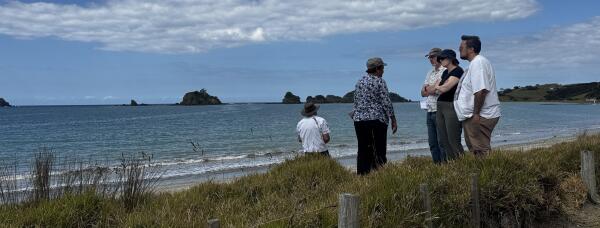
Ngātiwai kuia Bella Thompson shares stories of loss – and determination to hold on to local stories and mātauranga – with Commission visitors at Tuparehuia (Bland Bay). Photo / Whangarei District Council.
How communities are responding to the impacts of the changing climate in Te Taitokerau/Northland – and the ripple effects being felt across the region – is the subject of newly released work by He Pou a Rangi Climate Change Commission.
The case study provides a view of climate impacts and responses unfolding in Te Taitokerau/Northland, illustrating the breadth and depth of climate change experiences in the region’s communities. This work highlights what people recognise they can best lead locally and what support they see is needed from government.
“For an inherently local issue like climate adaptation, we need to understand what is happening on the ground,” says Jo Hendy, Chief Executive of the Climate Change Commission.
“When we visited the region to hear how people, communities and businesses are experiencing the growing pressures of a changing climate, the message we heard repeatedly was not concern that climate change is coming – it was that it’s happening now.”
“People told us about the climate impacts on their coastal and marine areas, rivers, whenua and forests – and the kai systems, livelihoods and communities based on them.
“Meanwhile, regional infrastructure – from roads to energy to communications – is often disrupted by increasingly frequent and severe weather events. These breakdowns cut communities’ access to essential services and are damaging to the local economy,” Hendy says.
“I was struck by the determination and innovation shown by the people we met with. These communities and businesses aren’t waiting for further impacts to hit. They’re already figuring out responses to meet their needs and aspirations – solutions created and implemented by the people that need them.”
“From trialling new crops, strengthening flood protections through to localising energy security, we saw community-led responses designed to protect lives, livelihoods, and community connections.”
“We heard that for these actions to grow into the comprehensive response Te Taitokerau/Northland needs, they’re dependent on critical inputs from government,” Hendy says.
“People we spoke to said they wanted reliable access to information and data, long-term policy and funding pathways, and investment in infrastructure that would keep people connected and safe. They also wanted greater clarity about roles and responsibilities in government legislation and national plans.”
The Commission also heard strong calls for the government to support community-led approaches.
“People told us that responses that are founded on their community’s strengths and values allow them to focus on adapting in ways that help everyone to cope and build resilience,” Hendy says.
“They told us that when they are supported to lead local adaptation action, they can weave in broader goals, such as regional economic growth, addressing community needs, better integrate Māori leadership and knowledge, and build collaborative partnerships that connect across communities and sectors.”
This case study is the first the Commission has released outside of its statutory reports, which combine local insights with a wide range of other evidence and analysis.
“People we talked to were keen for their stories to be shared to support other communities building their own responses.”
“We’re grateful to everyone who took time to meet with us and share their experiences and observations, and their willingness to share what is needed to thrive in their communities.”
Read a shorter, scrollable online version (opens external website)
About case studies
- He Pou a Rangi Climate Change Commission uses case studies as part of our mahi on adapting to climate change. They are central to our research approach to help us better understand how climate change affects Aotearoa New Zealand at the local level, and how communities are responding.
- The insights that communities share with us are also useful to others working in adaptation in central and local government, business, hapori/communities and beyond. Many of the people we talked to in Te Taitokerau/Northland hoped their experience could be helpful to other regions.
- Read more about our case studies and why we create them.