News
Spot the difference: Climate hazards and risks
27 February 2026
Recent severe weather around the motu has put climate resilience firmly into the national conversation. Holly Walker, project director for the 2026 national climate change risk assessment, explains how the Commission uses the terms hazard and risk in its work on adapting to climate change.
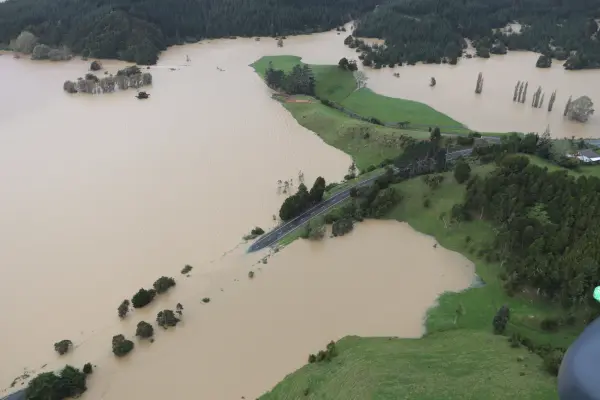
Flooding at Tangiterōria, a settlement between Dargaville and Whangārei, blocks State Highway 14 following Cyclone Gabrielle in February 2023, during the region’s wettest summer on record. Image credit: Kristen Edge, NZ Police
For many people, thinking about the impact of climate change understandably prompts questions like:
‘Will my home flood?’
‘Will the next big windstorm close the road?’
‘Are we going to be hit by drought again?’
You might think about these as questions about risks or hazards, and many people use those interchangeably – but in a climate change risk assessment, and other work on climate adaptation, they have specific meanings.
Climate hazards are the physical elements of climate change that create problems for us, such as extreme weather events or sea-level rise. They are one factor in a climate risk.
Climate risks are the consequences we might experience as a result. As well as a hazard being a factor, a risk also includes exposure (who or what might be affected) and vulnerability(how someone or something might be affected and the ability to adapt).
Here's an example:
Intense rainfall occurs (as a result of warmer seas, which feed more moisture into a storm). The rainfall causes surface flooding. That is a climate hazard.
When surface flooding overloads stormwater and sewage systems, the community's drinking water could be contaminated. Looking at this as a climate risk would take into account how much the water infrastructure is exposed (for example, if it is in a low-lying area), and how vulnerable it is to that hazard (for example, if it is older and more likely to fail in a flood).
Our upcoming national climate change risk assessment looks beyond the weather itself to help highlight how climate risk is reshaping the systems we rely on – from infrastructure and health to the economy and environment. It will also help clarify where proactive planning and upfront investment can make the biggest difference.
The next national climate change risk assessment is expected to be released in May 2026.