2026 National climate change risk assessment
About this report
Release date: 7 May 2026
This is the Commission's first national climate change risk assessment. This report looks at how Aotearoa New Zealand may be affected by climate change-related risks, and where focused and coordinated action can make the biggest difference.
This report is required under section 5ZP of the Climate Change Response Act 2002.
This 2026 assessment identifies the most significant risks to Aotearoa New Zealand's economy, society, environment, and ecology. It assesses the nature of the risks, their severity, and the need for coordinated actions to respond to them. This will help inform the government's next national adaptation plan, due in 2028.
We have published our work in four parts: a shorter Priorities for action report, a Full assessment report, a companion report Ngā mea hirahira o te ao Māori, and a Summary of method report.
We have also produced a short guide to this risk assessment [PDF, 368 KB] to help you navigate these reports and find the sections of most interest or relevance to you.
All parts of our assessment are available below, along with an executive summary, supporting evidence, external reviews, and more information.
Skip to a section on this page:
- Primary reports
- Summaries
- Case studies
- Companion reports
- External reviews
- At a glance: Executive summary
- Full table of risks and scores
Learn more:
Priorities for action report
The Priorities for action report presents the most significant risks identified in Aotearoa New Zealand’s second national climate change risk assessment, where action can make the biggest difference for people, places and ways of life. This report also provides a summary of recent projections for climate change.
Title: Priorities for action: 2026 National Climate Change Risk Assessment for Aotearoa New Zealand
ISBN: 978-0-473-78418-8 (Print); 978-0-473-78417-1 (Online)
Download:
Priorities for action - Lower resolution version [PDF, 16.01 MB]
Priorities for action - Full resolution version [PDF, 27.7 MB] – warning, large file
Full assessment report
The Full assessment report presents the analysis and scoring of all 37 risks across the seven domains assessed in Aotearoa New Zealand’s second national climate change risk assessment. It includes a detailed presentation of current information about climate change in Aotearoa New Zealand.
Title: Full assessment: 2026 National Climate Change Risk Assessment for Aotearoa New Zealand
ISBN: 978-0-473-78416-4 (Print); 978-0-473-78415-7 (Online)
Download:
NCCRA: Full assessment report [PDF, 5.7 MB]
Companion report: Ngā mea hirahira o te ao Māori
Ngā mea hirahira o te ao Māori is a companion report by researchers from the Bioeconomy Science Institute (Manaaki Whenua – Landcare Research Group) and Ngā Pae o te Maramatanga. It provides an independent kaupapa Māori assessment of seven national climate-related risks that specifically affect iwi/Māori.
Title: Ngā mea hirahira o te ao Māori: Climate change risks to the Māori domain (November 2025)
Download:
Ngā mea hirahira o te ao Māori [PDF, 2.8 MB]
Summary of method
The Summary of method report describes the method used by the Commission to carry out the assessment, including how the method was developed, how the assessment was carried out, and how the most significant risks were identified.
Title: Summary of method for the 2026 National Climate Change Risk Assessment for Aotearoa New Zealand (April 2026)
Download:
Summary of method report [PDF, 963 KB]
Report summaries and guides
The ‘At a glance’ executive summary presents the most significant risks in a summary for decision-makers, as well as providing a high-level introduction to the assessment for a general audience.
Skip to the executive summary further down this page, or download it as a file below.
Download:
NCCRA: Executive summary [PDF, 14.2 MB]
The three-page summary provides a condensed snapshot of the assessment and its findings.
Download:
NCCRA three page summary [PDF, 6.6 MB]
This four-page document provides short high-level descriptions of what is contained in key chapters of the different reports that make up this risk analysis, including page references, to help readers navigate quickly to the findings of interest or relevance to them.
Download:
Guide for users: How to navigate the 2026 national climate change risk assessment [PDF, 368 KB]
Case studies
The Northland case study themes report provides insights from people, businesses and communities in and around Te Taitokerau/Northland who are facing climate-related risks and impacts, who are at different stages of preparing and adapting.
This themes report has been adapted from a full case study, which is also available on our website.
Download:
Case study themes report: Te Taitokerau/Northland [PDF, 447 KB]
The Westport case study themes report provides insights from people, businesses and communities in and around Westport who are facing climate-related risks and impacts, who are at different stages of preparing and adapting. The full case study will be published by the Commission by the end of May 2026.
Download:
Case study themes report: Westport [PDF, 433 KB]
This document is a 'mini case study' by Sustainable Hawke’s Bay of the ongoing cascading impacts of Cyclone Gabrielle in the region. It demonstrates how a single climate-change-related extreme weather event can trigger cascading environmental, economic, and social consequences.
Download:
Cascading impacts of Cyclone Gabrielle in Te Matau-a-Māui, Hawke’s Bay: An illustrated report [PDF, 2 MB]
This accompanying infographic is based on the Sustainable Hawke's Bay mini case study (see above) and illustrates how Cyclone Gabrielle triggered cascading environmental, economic, and social consequences in the region.
Download:
Infographic: Cascading impacts of Cyclone Gabrielle in Hawke’s Bay [PDF, 3.35 MB]
Supporting material
Ngā mea hirahira o te ao Māori is a companion report by researchers from the Bioeconomy Science Institute and Ngā Pae o te Maramatanga. It provides an independent kaupapa Māori assessment of seven national climate-related risks that specifically affect iwi/Māori.
Download:
Ngā mea hirahira o te ao Māori [PDF, 2.8 MB]
This short report from the Bioeconomy Science Institute (Manaaki Whenua – Landcare Research Group) provides insights into climate-related risks and actions that the rural sector may take to prepare for or adapt to those risks, based on the inclusion of specific questions into the researchers’ 2025 Survey of Rural Decision Makers.
Download:
Survey of Rural Decision Makers 2025 [PDF, 1.8 MB]
The cascading risks report by consultancies Deliberate and Urban Intelligence helps better visualise and understand cascading climate change risks from extreme rain and wind on infrastructure, and from drought with a particular focus on the agricultural sector. It is based on in-person workshops with sector stakeholders hosted by the Commission.
Download:
The cascading risks of climate change in infrastructure and agriculture (November 2025) [PDF, 5.56 MB]
The Social vulnerability assessment from Urban Intelligence provides insights at the territorial authority level into which groups of people may be most at risk from coastal flooding and why they might have heightened social vulnerability.
The data used in this assessment is also available to download.
Download:
Social vulnerability assessment (October 2025) [PDF, 6.5 MB]
Raw data (New Zealand) [CSV, 6 KB]
Raw data (per district) [XSLX, 55 KB]
This document summarises three cascading risk archetypes based on ongoing research by Urban Intelligence. It was used by the Commission to advance its thinking on cascading risk in the assessment.
Download:
Cascading Risk Archetypes (April 2026) [PDF, 2.2 MB]
The Impact of sea level rise on groundwater and pasture production in New Zealand report provides the first national-scale estimate of how rising groundwater from sea-level rise could affect pasture production in New Zealand.
Report:
Impact of sea level rise on groundwater and pasture production in New Zealand [PDF, 5.12 MB]
Data:
Sea level rise and groundwater - data [.ZIP, 577 KB]
GeoTIFF files:
These zip files have been grouped by average depth to water (DTW), each containing geoTIFF files for sea level rise (SLR) scenarios of 0.5m, 1m, 1.5m and 2m.
average dtw 1m optimistic [ZIP, 3.8 MB]
average dtw 1m median [ZIP, 3.9 MB]
average dtw 1m conservative [ZIP, 4 MB]
average dtw 2m optimistic [ZIP, 4 MB]
average dtw 2m median [ZIP, 4.1 MB]
average dtw 2m conservative [ZIP, 3.3 MB]
The National Climate Hazard Exposure Census establishes a baseline of climate hazard exposure for Aotearoa New Zealand, quantifying the population, buildings, infrastructure and land exposed to a range of climate hazards.
Report:
National Climate Hazard Exposure Census [PDF, 13.7 MB]
The data below were supplied to the Commission from Earth Sciences New Zealand after the assessment and scoring of risks was complete. The data were used in the summaries of current and projected climate change and resulting hazards that appear in the reports, but did not inform the scoring and prioritisation of risks. Any errors in the data are as they were supplied to the Commission.
Data:
Supplementary data [.ZIP, 2.89 MB]
Between November 2024 and March 2025, the Commission called for evidence to support this risk assessment. We received over 100 submissions.
Where respondents gave us permission to do so, we have published their submissions on our consultation platform:
Published responses: Call for evidence - National climate change risk assessment 2026
External reviews
This document summarises the three international reviews undertaken for the assessment, how key feedback from those reviews was addressed, and possible areas for attention in future risk assessments.
We engaged three international experts to review elements of the project methodology, process and conclusions:
- Paul Watkiss (Director, Paul Watkiss and Associates, United Kingdom). Watkiss reviewed the project methodology based on an advance draft of the Summary of
method report in late 2025. - Marc Zebisch (Head of Center for Climate Change and Transformation, Eurac Research, Italy). Zebisch reviewed the project’s approach to assessing
cascading risk in late 2025. - Kevin Hennessy (Director, Climate Comms, Australia). Hennessy reviewed draft results and conclusions of the assessment in early 2026.
Download a summary of these international reviews:
NCCRA Summary of international reviews [PDF, 90.2 KB]
Each review is available below.
This international review by Paul Watkiss (Director, Paul Watkiss and Associates, United Kingdom) provides an independent international review of the overall assessment methodology.
Download:
Paul Watkiss review (December 2025) [PDF, 469 KB]
This review by Marc Zebisch (Head of Center for Climate Change and Transformation, Eurac Research, Italy) provides an independent international review of the methodology used for cascading risks in the assessment.
Download:
Marc Zebisch review [PDF, 105 KB]
This review by Kevin Hennessy (Director, Climate Comms, Australia) provides an independent international review of the results and conclusions of our assessment.
Download:
Kevin Hennessy review [PDF, 667 KB]
At a glance: Executive summary
This executive summary has been adapted from the first part of the Priorities for action report. To view it in context, see the original report: Priorities for action - Lower resolution version [PDF, 16.01 MB]
Download a copy of this executive summary:
NCCRA: Executive summary [PDF, 14.2 MB]
Summary for decision makers
Climate change is increasingly affecting the core systems in Aotearoa New Zealand – the essentials that keep daily life running, the wellbeing of communities, the natural environment that supports life and livelihoods, and the way the country plans, decides and acts together.
This report sets out the 10 risk areas that stand out in the country’s second national climate change risk assessment.
These are the significant risk areas where focused action would make the biggest difference. These risks are already seriously affecting people, or will soon, and will take time to prepare for. And they are the risks where acting soon can have the biggest influence on many other risks.
They are shown under four categories:
- key infrastructure
- communities and safety
- nature and the bioeconomy
- decisions and funding.
Figure A.1: The ten most significant climate-related risks

Source: Commission analysis
The 10 significant risk areas are set out below. See Chapter 3: Findings of our Priorities for action report for more information on these 10 significant risks, and the watchlist. Table A.1 shows the assessment ratings of all 37 climate-related risks – which are covered in more detail in our Full assessment report.
Key infrastructure
|
|
Risks to water infrastructureThis risk is about the infrastructure that provides people with drinking water, carries stormwater away from towns, and manages sewage. Climate change will put increasing pressure on every part of this system, which is already under strain. Drinking water pipelines are exposed to river and surface flooding, and drinking water supplies face increasing stress from drought, declining water quality, and higher temperatures. Rising seas, coastal flooding and more frequent and intense rainfall events threaten wastewater and stormwater networks. As climate hazards continue to intensify, water services will be increasingly affected. For daily life, this could mean more service interruptions, boil water notices, or burst pipes, with flow-on risks to rivers and beaches, lost productivity for businesses and communities, and public health implications. Some communities could even face the eventual withdrawal of services. The risk is greater because much of the infrastructure is already in a degraded state. Major reforms to water infrastructure management are underway and present an important opportunity to plan for and embed resilience to climate hazards. It is one of the most significant risks because critical services need to be immediately secured, and because action to strengthen the resilience of water infrastructure will help with many other climate-related risks. If it is not addressed, our assessment indicates it will be the first climate risk to reach an extreme severity level within the next 25 years. Risks to buildingsBuildings across Aotearoa New Zealand are exposed to a range of climate-related hazards that threaten both their structural integrity and performance. Flooding is a prominent hazard. Hundreds of thousands of buildings are in areas prone to flooding. For example, approximately 556,000 buildings are currently exposed to inland flooding, with a combined replacement value of NZ$235 billion. Most buildings in Aotearoa New Zealand were not designed with high temperatures in mind. Under future climate conditions, this could make them at times unliveable, posing acute health risks. Some building types are more vulnerable because of their age, design, or foundation, while others were built in areas now understood to be hazard prone. Households with fewer financial resources will find it harder to strengthen their homes, relocate away from hazards, or absorb higher insurance costs. In some regions, the level of exposure to hazards will be beyond what can be managed, and people may need to move. This is identified as one of the most significant risks because of the centrality of buildings to daily life, and because better management of climate-related risks to buildings will help address challenges around insurability, displacement, and community cohesion. Risks to road and rail networksClimate hazards are putting increasing pressure on the country’s road and rail networks, causing both short-term disruption and long-lasting damage. Climate change is expected to reduce the reliability and service levels of road and rail networks in a variety of ways, from more frequent closures, delays, and speed restrictions to higher maintenance and repair costs, and more frequent emergency works. A large proportion of the network is already exposed to climate hazards: for example, around a quarter of roads and more than a third of rail lines are in areas exposed to surface, river, and coastal flooding. Transport networks play a crucial role in national resilience. They connect communities, support emergency responses, and keep supply chains functioning. This is a significant risk because when roads and rail fail, the effects ripple far beyond transport. Much key infrastructure is tightly bound up with road and rail corridors, while the emergency management system, critical supply chains, and large sectors of the economy also depend on reliable transport networks. Strengthening the resilience of road and rail networks will help to address many other climate risks
|
Communities and safety
|
|
Risks to social and community wellbeingThis risk is about the increasing impacts of climate change on people’s wellbeing – impacts the country is not well prepared for. It brings together two of the assessed risks that are closely connected in real life: what can happen when people choose or are forced to move by climate impacts, and the wider risk of effects on mental health from climate change. The experience of devastating extreme weather events can cause long-lasting hurt, grief and fear that affects people’s health. For example, in a survey of people affected by Cyclone Gabrielle one year later, 43% of respondents reported a direct negative mental or emotional impact. Indirect impacts of climate change – including uncertainty about housing and livelihoods – can erode people’s sense of safety and belonging. This is heightened when ongoing and progressive climate hazards, such as sea-level rise, threaten places that matter deeply to people, and communities have to consider moving permanently. While in some places it may be a necessary solution in the face of repeated climate pressure, the prospect of relocation (particularly when it comes suddenly) can break relationships, divide communities and undermine trust in institutions. Planning and managing relocation well, working together with the affected communities, can help reduce those effects. This is one of the most significant risks because of the high human and financial costs: both when people are forced to move, and when there is little relief for climate-related distress, grief, discontent and uncertainty. There are long lead times for the measures that would reduce this risk, so it is important to start as soon as possible. Risks to emergency managementThe country’s emergency management system is under acute pressure and may struggle to respond to the increasing frequency, severity and extent of disasters that can result from climate hazards. Pressure on the system from climate change is already rising: in the past five years, 80% of the declared states of emergency were for severe weather or flooding. Strong emergency management saves lives and livelihoods, reduces injuries and trauma, limits damage to homes and businesses, and supports the long-term health, economic and social conditions in communities. The system is made up of people who work in a wide range of organisations, at community level, as full- and part-time workers and as volunteers. Together they are facing a steepening challenge. Reviews following recent disasters have highlighted an urgent need to strengthen the emergency management system. The signalled changes in current reforms are promising, but it is too early to assess their potential to deliver the improvements needed to respond to the increasing frequency and scale of climate change impacts. This is one of the most significant risks because the current emergency management system lacks the capacity or capability to deal with significant, complex, widespread events impacting multiple regions at once. Ngā mea hirahira o te ao Māori – risks in the Māori worldClimate hazards interact with longstanding structural factors to create a set of interconnected risks that specifically affect whānau, hapū and iwi. For iwi/Māori, climate change is not only a physical or economic problem. It reaches into identity, language, knowledge, governance and intergenerational wellbeing. Many cultural sites of significance to iwi/Māori sit in places now highly exposed to climate hazards. Access to taonga species is already changing in some rohe as marine heat, acidification, sedimentation and extreme weather events affect habitats and traditional harvesting practices. Economic impacts will be felt in the climate-sensitive primary sectors where there are high levels of iwi/Māori ownership and employment. Climate change also exacerbates existing health risks for iwi/Māori. Many of the climate risks for te ao Māori arise not only from physical hazards, but from legal exclusion and inconsistent recognition of decision-making rights. This is one of the most significant risks because climate change compounds the effects of distinctive historical, cultural, legislative, and economic conditions that continue to shape iwi/Māori resilience. This results in increased exposure to climate hazards and further constrains the adaptation options available to iwi/Māori. The inclusion of an ao Māori domain has been a key development since the first risk assessment in 2020. It was analysed by independent kaupapa Māori researchers whose report is published in full alongside this assessment (see supporting material at the top of this page). Their findings support its inclusion as one of the most significant risks.
|
Nature and the bioeconomy
|
|
Risks to ecosystems and biodiversityClimate change is affecting the country’s ecosystems – including land (terrestrial), freshwater, coastal and marine ecosystems – and indigenous biodiversity. Increasing land and marine temperatures change the environmental conditions species live in, while extreme weather events and wildfire cause shocks to ecosystems. This risk is greater because of existing pressures and threats to the country’s ecosystems such as land degradation, invasive species, resource extraction and pollution. Under the higher climate impact scenario considered (see Box 1.2), from around the middle of the century the combined effects of climate change and existing pressures on ecosystems could push some systems past a point where they can recover. The consequences are important not only for the intrinsic value of ecosystems, but also for the effects that will flow across all aspects of life: water, soil and air quality, the viability of jobs and businesses that depend on nature, the health of individuals and communities, and cultural and recreational connections to nature. We have combined climate-related risks to ecosystems and biodiversity into one significant risk because they are interconnected – with each other and with the wider risks in the assessment. Addressing risks to one ecosystem type is likely to reduce risks to others, while strengthening the resilience of these systems together will help to address many other climate-related risks. This makes it a priority for action. Risks to forestryThis risk is about how climate change will affect the country’s managed and production forests, and how the sector can better prepare for these impacts, including extreme weather, drought and wildfire, and new pests and disease. Forestry delivers a suite of benefits to the country: wood products, export earnings and removal of carbon dioxide from the atmosphere. The sector is growing rapidly in both value and area, with the area in managed and production forests expected to nearly double over the next 50 years. It is also central to the country’s action to reach net zero emissions. Damage to these forests reduces not only their capacity to absorb carbon dioxide and the sector’s economic contribution, but also exposes waterways and downstream communities to devastating sediment and debris flows. This is one of the most significant risks because the risks to forestry from climate change are already great and there is a need to accelerate adaptation planning and action in forestry to increase resilience. Most forests planted now will not reach harvest age for more than 20 years – meaning they will grow under changing environmental conditions and intensifying extreme events. Acting now will help avoid locking in future outcomes that increase the risks to forestry. WatchlistWe are also highlighting two closely related risks as ones to watch for the speed at which their severity might change. These are the risks to pastoral agriculture, and the risks to horticulture. These risks were rated at minor severity at present, but they are expected to move to major by 2050. Our assessment shows that as a range of climate hazards affect the productivity and profitability of these key economic sectors (see Risks to watch: agriculture and horticulture in Chapter 3: Findings), the impacts are likely to reach into other areas of the economy. This warrants early attention and preparation.
|
Decisions and funding
|
|
Risks to central and local government fundingThis risk is about the growing pressure that climate change places on both central and local government finances. This is in the context of many councils, especially smaller ones, already facing constrained budgets or having already reached their debt limits. As climate impacts intensify, governments face higher costs for disaster response, infrastructure repair, welfare and health services, and long-term adaptation. Disasters like the 2023 severe weather events in the North Island – which cost the Government NZ$6.65 billion – are hard to budget for because their exact timing, location, and scale can’t be predicted. Yet they will become more frequent and extreme as climate change intensifies. At the same time, climate-related impacts on the wider economy – including on primary industries – can reduce revenue from taxes and rates. Together, higher and more volatile expenditure and more uncertain revenue threaten governments’ ability to maintain essential public services, invest in resilience, and plan for the long term. The importance of central and local government funding for the operation of the whole country and economy makes this one of the most significant risks. Recent research suggests that 97% of the Government’s expenditure on natural hazards since 2010 has been on responding to and recovering from disasters, with only 3% on risk reduction and resilience. If central and local government are forced to spend more on repeatedly recovering from natural disasters rather than planned adaptation, it could become harder over time to fund other core services such as health and education, pushing the costs on to future generations. Risks to decision-making and deliveryThe demands of climate change are putting Aotearoa New Zealand’s ability to plan, decide and act together under increasing pressure. This risk area is focused on what is needed to support adaptation in ways that work for everyone in the country, and that can endure the pressure of intensifying impacts. It includes assessment of risks to how central and local government work together, how well people trust democratic institutions as they come under pressure for difficult decisions, and to the Crown’s ability to uphold Te Tiriti o Waitangi/The Treaty of Waitangi. As climate change hazards intensify, the kinds of issues that require stable decision-making and effective delivery are becoming more complex. The country needs to be able to drive forward on adaptation, to reduce the escalating impacts and costs of climate change. Otherwise, decision-makers will be increasingly caught up in urgent responses, which take time and resources away from planning for the future and reducing harm, and could result in locking in future vulnerabilities. This is one of the most significant risks because of the need for immediate action. It will take time to work through adaptation decisions and implement policy and programmes that match the speed and scale of climate change – especially to do this in ways that build public trust and confidence, and uphold the Crown’s responsibilities under Te Tiriti/The Treaty.
|
What this assessment provides
Comprehensive scan at national level
The 2026 national climate change risk assessment provides a scan of the country’s climate-related risks, focusing on the potential consequences for people, places and ways of life, and where effort can go to reduce harm.
The assessment looks closely at how climate change acts on different aspects of life, and what is in place to respond to those effects.
The scope of the assessment is national and broad ranging, considering not only how climate change could change the natural environment and the towns and cities that people live in, but also the economy, te ao Māori, the health and wellbeing of communities, and potential future implications for decision-making and funding. The process raises those specific issues to national risks, which can inform government action to adapt to the changing conditions.
Because of its broad scope, the assessment relies on a wide range of evidence from many sources. It uses expert judgement from the Commission and others to interpret that evidence and draw conclusions.
Priorities for action
The most significant risks are the climate-related risk areas where our assessment suggests focused action under the Government’s next national adaptation plan can make the biggest difference and achieve the greatest system-wide impact.
Decision-makers have a range of options available to address the risks. These include accelerating and joining up work already underway by the Government and supporting coordinated adaptation around the country (including providing clarity about how costs can be shared and met).
Action to address the challenges presented by climate change can return benefits that strengthen the economy, society and the environmental foundation of the country. Investing attention and resources into carefully prioritised adaptation action would substantially reduce future costs and losses associated with climate change.
Acting to strengthen the country’s underpinning structures and tools – such as funding and financing systems, trust in democratic institutions, social connections and wellbeing – will be important to support the adaptation needed for climate change.
A view of what is underway
Action has begun in many ways across the country. The assessment reflects what is underway at central and local government level, as well as identifying what other actions can help to reduce the impact of climate change.
This report includes examples of what is happening already within local communities and businesses – the kinds of adaptation action that will be essential across the country, and which can be strengthened with comprehensive national planning.
A summary of climate change already happening and projections for the future
Chapter 2: Climate change in Aotearoa New Zealand provides a summary of current and projected climate change and the hazards that result, based on updated data, with information about people and infrastructure exposed to those hazards. This shows:
- Climate change is reshaping the hazards that the country faces
Communities, ecosystems and infrastructure in Aotearoa New Zealand are exposed to shifting and intensifying pressures in 2026. As well as the physical hazards people in this country are used to dealing with (such as earthquakes), there are new – and intensifying – hazards from climate change that are creating challenges outside historical experience. Warming air and oceans, rising seas and changing physical and chemical patterns in the atmosphere and oceans are driving more frequent, intense and compounding extremes – especially extreme rainfall and flooding (inland and coastal), rainfall-induced landslides, heat extremes, drought, marine heatwaves and ocean acidification. - This is not business-as-usual hazard management
Climate change is shifting the country’s ‘normal’. Hazards are becoming more acute, as progressive changes and extreme events load on top of other challenges. The interval between damaging climate-related events is reducing, while the underlying conditions (such as air, water and soil temperatures) are altering. This combination is going to require ongoing adaptive management – systems will need to change in response: how water is managed, how homes are kept safe, how people farm, how decisions are made. - Supporting global efforts to limit warming is integral to climate risk management
Chapter 2: Climate change in Aotearoa New Zealand sets out projected differences in climate variables and their effects at two different levels of global warming later this century. Higher global warming levels drive more severe and widespread hazards, reduce the feasibility and cost-effectiveness of adaptation options, and increase residual risks and losses. Continued support for and contribution to global efforts to reduce emissions and limit warming shapes this country’s future hazard environment – it would help keep risks manageable and avoid reaching adaptation limits for communities and sectors.
What makes up the full national risk assessment
The Climate Change Response Act 2002 (the Act) requires an assessment every six years of the risks to the country’s economy, society, environment and ecology from current and future effects of climate change. This assessment is also required to advise the Government on the most significant risks requiring attention in the next national adaptation plan.
The 2026 assessment is the country’s second national climate change risk assessment. It was carried out by He Pou a Rangi Climate Change Commission (the Commission). It builds on the first assessment published by the Ministry for the Environment in 20201 and draws on the latest available evidence, international models for climate risk assessments, input from engagement with interested people and organisations through the process, and advice from expert reviewers.
Four reports make up the assessment.
- The Priorities for action report (where this executive summary appears) is focused on the most significant risks requiring immediate action to reduce serious consequences for people, places and ways of life. This report also provides a summary of recent projections for climate change.
- The Full assessment report covers all 37 risks assessed, and provides an overview across seven interconnected systems or ‘domains’ of risk (see list below). It includes a more detailed presentation of current information about climate change in Aotearoa New Zealand.
- A companion report, Ngā mea hirahira o te ao Māori, provides a kaupapa Māori assessment of seven national climate-related risks that specifically affect iwi/ Māori (these form part of the 37 risks).
- Our approach to assessment is described in a separate Summary of method report.
The reports and other supporting material are available at the top of this page.
The hazards that underlie the assessed risks
- Extreme events like extreme rainfall, marine heatwaves, wildfires.
- Progressing and ongoing hazards like sea level rise.
- Changes to variability like trends in temperature or rainfall.
What happens next
After publication of a national climate change risk assessment, the Minister of Climate Change must respond, within two years, with a new national adaptation plan. This needs to address the most significant risks identified in the risk assessment.
The Commission has a role advising on the implementation and effectiveness of the national adaptation plan, and on how future plans can be more effective. Our next progress report on adaptation is due by August 2026. That report will review progress under the existing plan, and will also contain advice for the next one.
Table A.1: The risks we identified and how they scored in the assessment
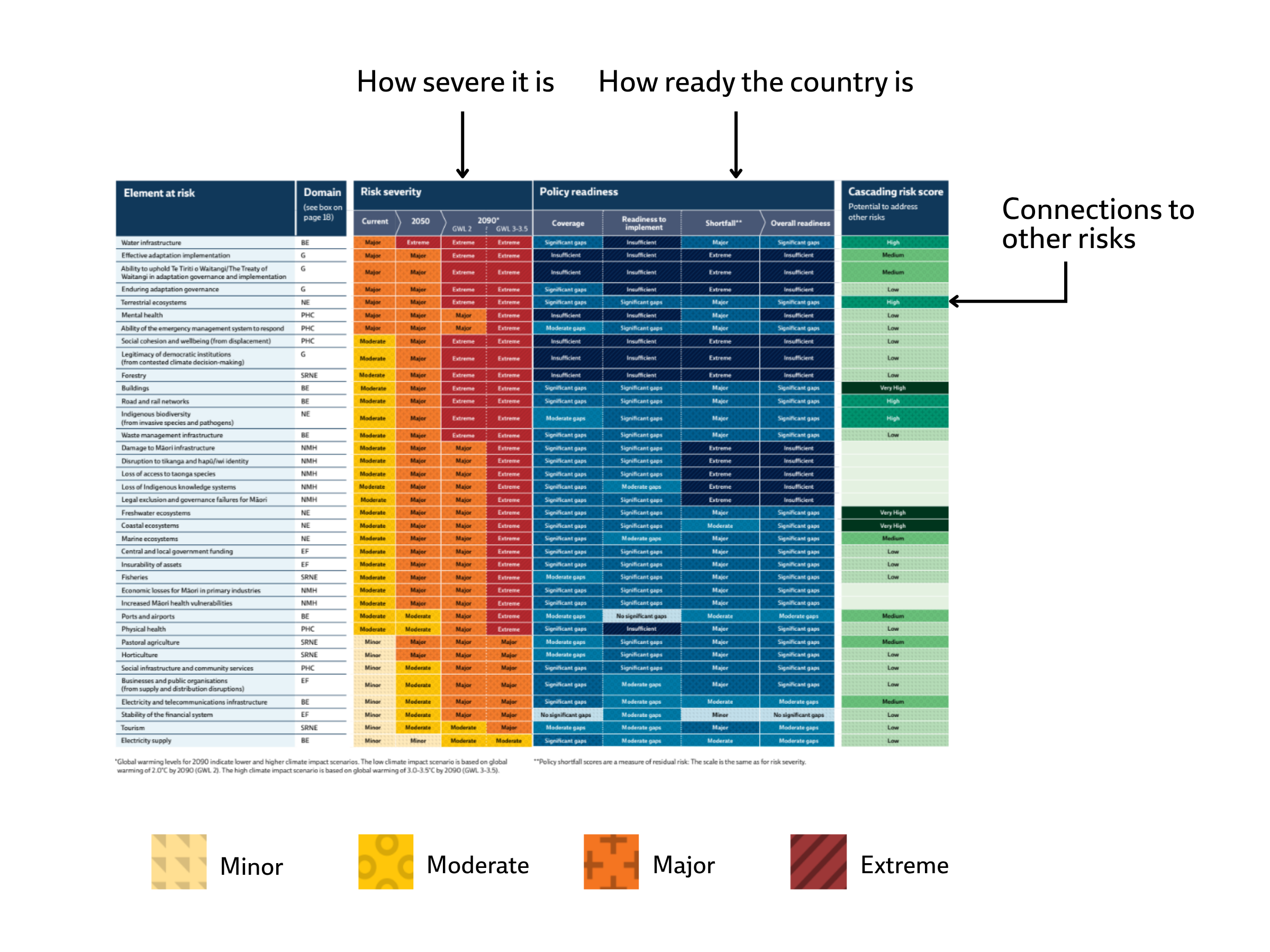
The risks are assessed in three ways
- How severe it is: the severity assessment looks at the nature and scale of the potential consequences of each risk; this is rated from ‘minor’ to ‘extreme’ for three periods (present day, mid-century, and end of the century).
- How ready the country is: the policy readiness assessment reviews existing government policies and plans and assesses how well they can address each risk; this is rated from ‘no significant gaps’ to ‘insufficient’.
- Connections to other risks: the indirect and cascading risks assessment examines the relationships between different areas, and identifies options for action in one area that could reduce multiple risks.
What the severity ratings mean
- Minor: There could be occasional, minor loss and damage, and temporary impacts.
- Moderate: There could be repeating loss and damage, and climate impacts could upset how well key systems run.
- Major: There could be large or frequent loss and damage, serious or long-term disturbance to people, places and ways of life, and disruption to whole systems.
- Extreme: There could be very large, very frequent loss and damage, permanent effects on people and the environment, and failure of systems. At this level, there is a high chance of reaching thresholds, when changes cannot be reversed.
See Chapter 1: Introduction of the Priorities for action report for the formal assessment criteria for risk severity, as well as for policy readiness and cascading risk scores.