NZ ETS settings
NZ ETS unit limits and price control settings for 2025–2029
Our 2024 advice on updating NZ ETS unit limits and price control settings for the next five years.
29 February 2024
About this report
This report is the 2024 edition of our annual advice to the Minister of Climate Change on updating the NZ ETS unit limits and price control settings, covering the years 2025–2029.
The Commission produces this advice as required by section 5ZOA of the Climate Change Response Act 2002.
Details & links
12 March 2024
3021-1956 (Print); 3021-1964 (Online)
- Technical Annex 1: Unit limit settings [.PDF – 876 KB]
- Technical Annex 1: Supporting spreadsheet [.XLSX – 561 KB]
- Technical Annex 2: Assessment of accordance [.PDF – 465 KB]
- NZ ETS Forestry Model: Information sheet [.PDF – 237 KB]
- NZ ETS Forestry Model: Workbook [.XLSX – 1.95 KB]
This technical annex and accompanying spreadsheet provide further information on the data, methodology, and key assumptions we have taken to reach our final unit limit settings recommendations. These document should be read alongside Part 3: Unit limits of our advice.
Download:
This ‘Assessment of accordance’ sets out how we have considered the requirements of section 30GC of the Act: that recommended NZ ETS settings are in accordance with emissions budgets, the nationally determined contribution (NDC), and the 2050 target.
Download:
This model projects allocations and surrenders of forestry NZUs since 2008, subject to user-variable assumptions. It contains data provided by the Ministry of Primary Industries. Within our analysis for NZ ETS settings advice, we have used this model to develop estimates of units held for post-1989 forest harvest liabilities, and of forestry emissions outside of the NZ ETS.
This model should be read in conjunction with the accompanying information sheet. Additional information discussing the assumptions applied within the model is detailed in Technical Annex 1.
Download:
Frequently Asked Questions: NZ ETS unit limits and price control settings for 2025–2029 [PDF, 371 KB]
Executive summary
Overview
This report is our annual advice to Government on the settings of the New Zealand Emissions Trading Scheme (NZ ETS). It focuses on two areas: adjustments to limits on the number of units in the scheme, and to the auction price control settings. Our advice is based on analysis of the system, its operating environment and its impacts; this also raises urgent policy questions.
The NZ ETS is a key policy tool for reducing the country’s greenhouse gas emissions. He Pou a Rangi Climate Change Commission has an annual task to check the scheme’s settings and advise any adjustments needed to keep the NZ ETS on track to support Aotearoa New Zealand’s targets for emissions reduction. Our assessment also considers the impact of emissions pricing.
This year we recommend a significant reduction of auction volumes and flag pressing concerns affecting the ongoing effectiveness of the NZ ETS. These are presented in the context of intensifying climate change impacts at home and across the world, reflecting our consistent identification that urgent Government action is required to broaden, strengthen and accelerate efforts to meet Aotearoa New Zealand’s climate change objectives.
This executive summary is an overview of the key elements of our 2024 advice on the scheme’s settings. It recognises the keen interest across Aotearoa New Zealand in understanding how the Government’s climate change response tools are working, and what improvements might be needed to support the country to make the transition to a thriving, low emissions economy.
Key points for decision-makers
An NZ ETS that is working well can help meet the country’s goals to reduce emissions in Aotearoa New Zealand. It can also help to meet the country’s international commitment – the Nationally Determined Contribution (NDC) – which combines emissions reductions in this country with reductions funded in other countries. This advice recommends changes to NZ ETS settings and highlights Government policy decisions needed to support the effectiveness of the NZ ETS.
Key issues for the settings updates
New information shows there are too many units in the NZ ETS: this increases the risk that the Government will not achieve the targets.
Our unit limit settings recommendations help the Government reduce this risk by reducing the NZ ETS auction volumes as soon as possible.
NZ ETS auctions are not a reliable source of income for Government.
The price control settings we advise on remain fit-for-purpose with inflation adjustments.
Key issues requiring Government policy decisions
There are policy issues limiting how well the NZ ETS works:
- Uncertainty about Government priorities and plans is affecting market and investor confidence.
- The Government’s next plan for reducing greenhouse gas emissions (due out this year) is a good opportunity for it to address the policy issues.
A key improvement would be for the Government to make clear statements about its goals for reducing greenhouse gases (at their source), and its goals for using forestry to absorb some emissions.
There is an urgent need for the Government to confirm how the country will achieve its NDC.
- The NZ ETS could be used together with other policies to help speed up emissions reductions at home.
- Emissions reductions in other countries – funded by Aotearoa New Zealand – will also be needed to meet the NDC. It is important to make clear whether the NZ ETS has a role in this.
Introduction
Why the NZ ETS matters for the transition to a low emissions economy
The NZ ETS is a key tool in the Government’s strategy to reduce greenhouse gas emissions and transition to a thriving, low emissions economy. The scheme operates alongside other government climate policy.
The NZ ETS is a market mechanism created by government to encourage choices that move away from activities that create greenhouse gas emissions, such as burning fossil fuels. It creates an ‘emissions price’ by limiting the volume of greenhouse gases allowed; in the NZ ETS this covers all sectors except agriculture. This ‘cap’ on emissions reduces over time, in line with emissions reduction targets.
The targets the scheme is designed to match up with are the Government’s five-year emissions budgets (which are the stepping-stones to the 2050 target), and Aotearoa New Zealand’s current Nationally Determined Contribution (NDC) – the country’s international commitment to reduce emissions.
However, the history and design of the NZ ETS, as well as uncertain Government climate policy, create challenges for aligning the scheme to those targets. It is now well into the 2021–2030 NDC period, but the plan for meeting the NDC and the role of the NZ ETS in that are still unclear.
The past 18 months have been eventful for the NZ ETS. The emissions price has moved sharply up and down in response to policy announcements and the four declined auctions held in 2023, where bids at the auctions did not meet minimum requirements so no units were sold.
The 2023 auction outcomes are not a failure but rather the result of the system operating as designed. They are, however, a demonstration of low market confidence and also reflect the large amount of units already in the market.
Over recent years, the cash proceeds from NZ ETS auctions have been a source of income to Government. The reliability of this income is uncertain. Selling units by auction is unlikely to generate steady funds in coming years, because the number of units auctioned is already set to decline in line with targets, and because the auction unit levels is the only setting that Government can adjust to keep permitted emissions in line with the country’s targets.
Our approach
In line with our role to provide independent, evidence-based advice to the Government we have analysed the latest data, considered the issues the Act requires us to address, and drawn on insights and evidence from engagement with iwi/Māori and stakeholders.
Our check of the NZ ETS settings uses a system approach, recognising that each setting interacts with other aspects of the scheme to affect the market.
This means our recommendations need to be read as a package. They include information about how the different parts of the scheme link up, to help the Government avoid unintended consequences as it makes decisions.
Our approach recognises that future reductions in greenhouse gases may not happen exactly as predicted. We treat the emissions budgets and the 2050 target as ceilings on emissions, rather than “bullseye” targets.
In our advice to Government the Commission considers the Crown–Māori relationship, te ao Māori, and specific effects on iwi/Māori. Our analysis and engagement with communities shows this will support faster emissions reduction and help achieve an equitable transition for the benefit of all New Zealanders – as set out in our December 2023 advice to Government on its next emissions reduction plan.
The matters considered in this year’s advice on NZ ETS settings include the wide variety of approaches taken by iwi/Māori entities to their decision-making about forestry management and their NZ ETS units.
This reflects the overall point, also made in our December 2023 advice on the second emissions reduction plan, that iwi/Māori interaction with the NZ ETS is affected by the specific characteristics and historical circumstances of land owned by Māori.
Decisions connected with managing land owned by Māori collective owners, including about using New Zealand Units (NZUs) from forests, are often subject to protracted administrative steps and can be strongly influenced by the need to weigh up a range of competing priorities, tikanga values, and kaitiaki obligations including taonga tuku iho.
The diversity of viewpoints we have heard on iwi/Māori perspectives on the NZ ETS indicate a careful and collaborative approach is necessary, including regarding co-design and related aspects under Te Tiriti/The Treaty (see also Part 2: Iwi/Māori perspectives on the NZ ETS).
The impacts of emissions prices on iwi/Māori connects with our consideration of impacts across the economy, as detailed in Part 4: Price control settings. This reflects the need to ensure the transition to a low emissions economy is both ambitious and achievable. Our analysis has shown a fair, inclusive and equitable transition will endure, because that kind of transition would anticipate and manage how decisions affect different groups of people around the country.
Many households and businesses will be able to take up options that involve lower levels of greenhouse gases (such as changing how they travel or move goods, or heat buildings), meaning emissions pricing will impact them less and less over time. Impacts of emissions pricing, however, are not felt evenly across communities. Some households are unable to afford low emissions options, some do not have access to them. This is particularly relevant now, as higher inflation over the past two years has caused more people to struggle with the cost of living. Our recent advice on policy options for the Government’s next emissions reduction plan recommends continued use of targeted support for people less able to cope with the impacts of emissions pricing, rather than delaying climate action.
What we heard through engagement
Effective engagement is an important part of the Commission’s process for developing advice.
For this advice we heard from mandated iwi/Māori representatives, companies, industry associations, market intermediaries including trading houses, and individual experts or consultants specialising in the NZ ETS.
We also drew on insights from past NZ ETS engagements, and engagements undertaken for other Commission work. An important input in the last 12 months was the public consultation and engagement that informed our December 2023 advice for the Government’s second emissions reduction plan.
The key themes arising from engagement were:
- Our NZ ETS settings analysis is sound:
Our methodology and recommendations were generally considered to be appropriate. - Uncertainty about rules and policy is undermining confidence in the NZ ETS:
This was consistent feedback across almost all engagements. The feedback highlighted Government decisions about price control settings and the (now stopped) review of the role of forestry in the NZ ETS in particular as discouraging investment in decarbonisation and forestry. - Feedback that forest planting is not likely to continue at rates seen in past years:
There was consistent feedback that recent high rates of forest planting were unlikely to continue in the immediate future due to policy uncertainty and other unfavourable conditions, with little planting planned for 2025. - More information on the NZ ETS market would be beneficial:
Some participants noted key information for understanding supply and demand was held by the Government but not available to the market; some also hoped that planned NZ ETS market governance reforms would improve market information. - Iwi/Māori perspectives on the NZ ETS:
As outlined above, representatives of iwi/Māori entitites provided diverse views reflecting interest but difficulty in navigating forestry elements of the NZ ETS.
The feedback is reported in more detail in Part 2: Current state and role of the NZ ETS.
About the NZ ETS
The NZ ETS is a market created by the government to support Aotearoa New Zealand to meet its emissions budgets, the 2050 target, and the country’s international commitment under the Paris Agreement, the Nationally Determined Contribution (NDC).
Putting a price on emissions changes the relative prices of goods and services across the economy. This influences the behaviour of both producers and consumers by discouraging activities involving high levels of greenhouse gases, and rewarding low emissions choices.
The NZ ETS covers every sector in the economy except agriculture: the scheme does not include biogenic methane and nitrous oxide emissions. Participants in the NZ ETS face the costs associated with emissions while being free to decide how best to reduce emissions.
There are several sources of units in the NZ ETS; each of those units (NZUs) represents a tonne of emissions:
- The Government awards units in the scheme to reward the growth of forests.
- Some units are allocated at no cost to businesses involved in specific activities that are both emissions-intensive and trade-exposed (this is ‘industrial free allocation’).
- The Government sells a limited number of units at auction, in line with a declining emissions cap.
Market participants trade units with each other on the secondary market.
Our annual advice on settings
The Commission is required by law to advise the Government annually on NZ ETS settings for the following five years: for three kinds of unit limits, and for two kinds of price controls (explained below). This supports the Minister of Climate Change to update system settings to keep the NZ ETS lined up with emissions reduction targets, and reward choices that have lower emissions.
This is the third time the Commission has provided this advice. It covers the settings for 2025–2029.
Three categories of unit limits
We advise on a limit on units available by auction (including reserve volumes); a limit on approved overseas units available for use (currently none); and an overall limit on units. These help implement ‘the cap’ on emissions permitted from the sectors covered by the scheme.
The Act specifies that changes to settings can be recommended only for years 3 to 5 of the cycle, unless there are special circumstances. This year we consider that threshold is met, and we recommend the Government changes unit limits from 2025.
Two categories of price control
We advise on the price controls that apply when the Government either sells reserve units (if the auction price reaches very high levels – this is the cost containment reserve), or withholds units from sale at auctions (the auction reserve price). These help manage the risk of unit prices at auction being out of line with what is needed to meet emissions budgets. Our assessment in 2024 is that these remain fit-for- purpose and only minor changes are required to reflect inflation.
Note: these price controls do not set the unit price at auction, and they do not apply to NZ ETS participants trading units on the secondary market.
What happens next for NZ ETS settings
This advice is one step within a wider process for updating the NZ ETS settings regulations.
The Government will consider our advice and run a public consultation on proposals, led by the Ministry for the Environment on behalf of the Minister of Climate Change. This is in the second quarter of 2024.
The Government must make decisions on NZ ETS unit limits and price control settings in time for the regulations to be updated by 30 September 2024. The new settings will come into force on 1 January 2025. We expect to provide our next advice on this topic, for the period 2026–2030, in the first quarter of 2025.
Other Commission advice relevant to the NZ ETS
This advice on the system settings for the NZ ETS is as required in the Act. We note this year it lands alongside other closely related advice and reports:
- In December 2023 the Commission provided detailed advice to inform the Government’s second emissions reduction plan (due in final form by the end of 2024). This included options Government has around amending NZ ETS incentives to accelerate the shift to a low emissions economy.
- In April 2024 the Commission will be consulting on draft advice on the fourth emissions budget and the 2050 target review, which will set out longer-term options the Government has to encourage emissions reductions.
- In mid-2024 the Commission will publish the first annual monitoring report showing our independent assessment of progress towards meeting emissions budgets and the 2050 target, and an assessment of the adequacy of the Government’s emissions reduction plan.
Critical issues for the settings updates
Dealing with surplus units already in the NZ ETS market
For the NZ ETS to work well to support emissions reductions, the units available for use in the scheme need to decline in line with the Government’s declining emissions budgets. This is to encourage a drop in the greenhouse gas emissions covered by the NZ ETS, at the rate that will achieve the 2050 target and the domestic emissions part of the NDC.
Over many years, the number of units in the market has grown significantly, built up over time from a variety of sources. Some of the units in the market are necessary for the smooth operation of the NZ ETS, but there is an excess share that presents a high risk to the achievement of the emissions budgets. We refer to these excess units as ‘the surplus’.
The Commission last estimated the surplus in mid- 2022. Our recent analysis shows the estimated surplus has grown from 49 million units to 68 million units at the end of September 2023. The greatest contribution in that period came from a large increase in units allocated to forests registered in the NZ ETS. Figure 1 shows the combined total of surplus units, industrial free allocation units, and units set to be auctioned under the current NZ ETS settings regulations. The graph makes clear the units available exceed the level of allowed emissions from NZ ETS sectors under the NZ ETS emissions cap. The graph does not include the additional 93 million units currently held in private accounts that are not considered surplus.
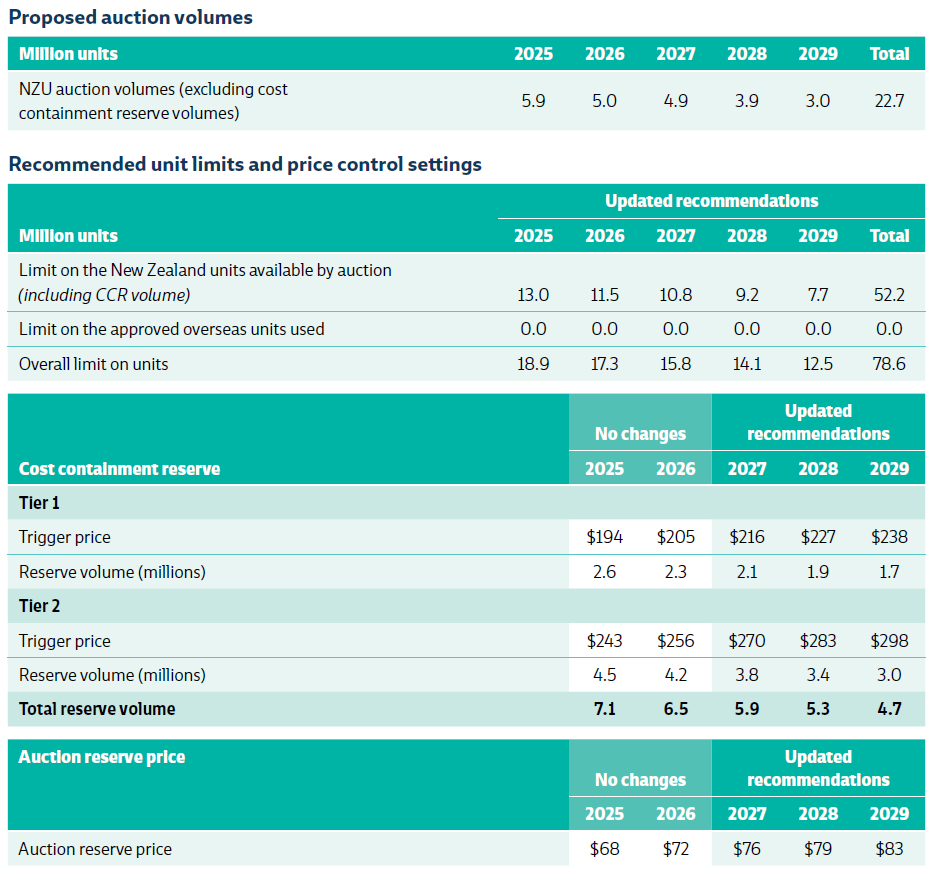
Currently there is only one way to correct the excess number of units. That is by reducing the volume made available in government auctions. Based on our estimate of the increase in the surplus this year, we are recommending unit limit levels that reduce auction volumes significantly – see Part 3 Unit limits: Step 1.
The Commission’s recommendations on unit limits are based on the same methodology as previous NZ ETS settings advice.7 This year, we have judged it is appropriate to recommend changes to the first two years of unit limit settings – we consider there are circumstances that satisfy the criteria for doing this. Adjusting from 2025 supports the scheme to align with existing emissions budgets.
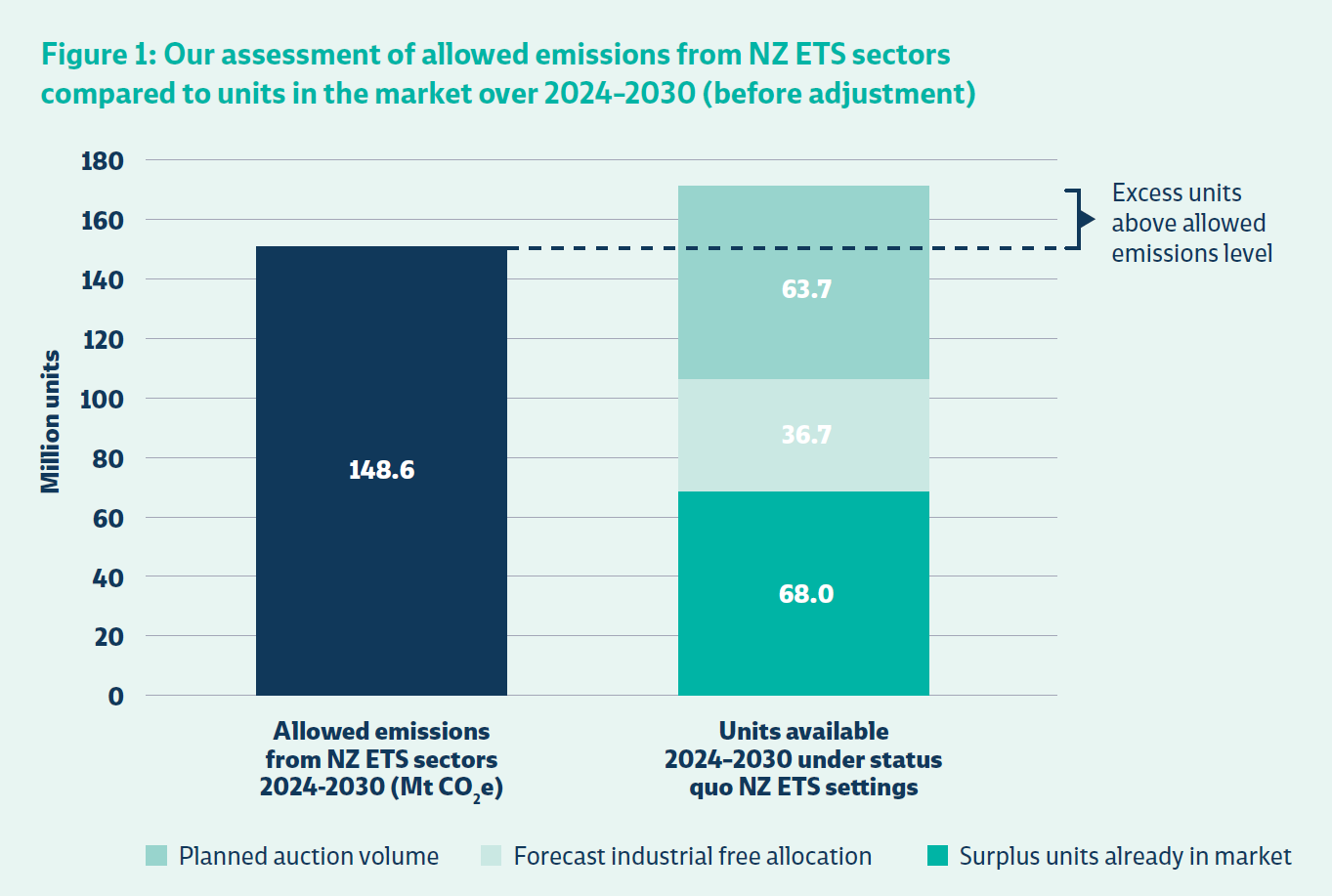
Figure 1: Our assessment of allowed emissions from NZ ETS sectors compared to units in the market over 2024–2030 (before adjustment)
It avoids the need for drastic reductions from 2027 that would be needed if the settings remained unchanged for 2025–2026, and allows room for further reductions later if the surplus is larger than estimated, or if it grows in the future. This recognises that factors influencing the surplus estimate are dynamic.
Other factors have also contributed smaller changes to the recommended auction volumes. These include an update to the overall emissions volume (the ‘emissions cap’) available to the NZ ETS due to methodological updates to the government’s Greenhouse Gas Inventory (GHG Inventory). These methodological updates are refinements to emissions calculations that bring estimated emissions down because of better data and information, rather than because of actions that reduce emissions – this is explained in detail in Part 3 Unit limits: Step 1.
Our recommendation also reflects a technical adjustment related to liquid fossil fuel emissions (as in our previous advice), an updated forecast of industrial free allocation, and refinements to more accurately reflect the NZ ETS’s coverage of synthetic greenhouse gases. Together these combine to give the proposed auction volumes that are set out in the Recommendations section.
Reliability of cash proceeds from NZ ETS auctions
Adjusting units in the scheme to align to targets – by reducing the volume of units available at auction – highlights the unreliability of income for government from the NZ ETS. This was already a reality, given the planned decline in auction volumes in line with emissions targets; this is currently expected to reach zero in the mid-2030s, at which point there will be no further units to auction. The current increase in the surplus, which leads us to recommend sharper adjustment to auction volumes, makes this unpredictability more acute.
Opportunities to bring unit limits down to support further emissions reductions
The Commission has identified opportunities to use the NZ ETS together with other emissions reduction policies to make the most of domestic emission reduction opportunities. This could help reduce the need to fund emissions reductions in other countries to meet the NDC – see also points about the NDC in the Clarifying the plan to achieve the country’s Nationally Determined Contribution section below.
Unit limits in the NZ ETS could be adjusted to reflect sizeable changes in emissions that result from other emissions reduction policies – where these are not already reflected in the related emissions budget. These are where there is a material shift in emissions by NZ ETS participants, and the reduction in unit limits could be made without increasing pressure on others in the scheme. One of several such examples is the action by NZ Steel in partnership with the Government to introduce an electric arc furnace to replace coal as a fuel for part of its manufacturing at Glenbrook Steel Mill. This is expected to reduce that company’s greenhouse gas emissions by 0.8Mt annually from 2027, which will be a permanent reduction to its demand for units in the NZ ETS (this shift away from coal will halve their use of units). The electric arc furnace was not anticipated in the Commission’s scenario pathway analysis in our 2021 advice on emissions budgets, unlike other emissions reduction projects funded by the Government Investment in Decarbonising Industry (GIDI) Fund.
The Government does not currently have policy on how the NZ ETS should be managed in these circumstances. It has the option to reduce the NZ ETS cap to lock in the reductions from other emissions reduction policies or investments. If the Government chooses not to adjust the cap, this would leave more units available and lower costs for other participants. Both options are available to the Government, but they have different consequences for the NZ ETS settings.
The option of reducing the emissions cap when step changes in emissions are achieved through other policies could increase certainty that domestic emissions budgets will be met, and make it easier to also meet the NDC by reducing reliance on offshore emissions reductions.
In the absence of policy direction, the Commission has deferred making a recommendation to tighten the NZ ETS cap this year to reflect the change in expected demand from emissions reduction policies outside the scheme. We are instead flagging this as an urgent policy issue requiring Government decisions, which could include setting out a framework for how the NZ ETS and complementary emissions reduction policies should interact.
Price controls are fit-for-purpose
We have assessed there is no need to change the NZ ETS price controls – the cost containment reserve and the auction reserve price – beyond an adjustment for expected inflation. The ‘price corridor’ that the auction price controls establish remains fit-for-purpose in combination with the unit limits.
Our analysis of price controls included an assessment of impacts of potential emissions prices – as covered in Our approach above.
Key issues requiring Government policy decisions
The NZ ETS is most effective at encouraging changes to lower emissions options if the scheme is operating as part of a cohesive suite of climate policies.
There are ongoing gaps in Government policy that affect the NZ ETS and create uncertainty for market participants. These issues are not the focus of the recommendations in this advice, but we raise them as they undermine the ability of the NZ ETS unit limits and price control settings to serve their purpose. If these issues remain unresolved, it will become increasingly difficult to accord the settings with emissions reduction targets in future. There is opportunity for the Government to address those issues in its next five-year plan for reducing greenhouse gas emissions (due December 2024).
This summary of the key policy issues provides an overview of the most important matters, as set out in Part 2 Current state and role of the NZ ETS.
Decisions needed on goals for gross emissions and carbon removals
The Government has not specified goals for the levels of gross emissions (reducing greenhouse gases where they are produced) or for the levels of carbon dioxide removed through forestry. Clarity from the Government on the levels sought, and the role of
the NZ ETS in achieving them, would support action to meet the emissions budgets and the net zero component of the 2050 target.
As part of our advice on the direction of policy for the second emissions reduction plan, the Commission recommended the Government commit to specific levels of gross emissions levels for the second and third emissions budgets, and provide indicative levels of gross greenhouse gas emissions and carbon dioxide removals out to 2050 and beyond, to guide policy decisions.
Structural improvements to encourage decarbonisation and forests
The NZ ETS is a key tool for meeting emissions budgets and the 2050 target but there are structural issues that prevent the scheme from achieving those goals in a stable way over time.
Addressing these structural issues will bring uncertainty, while solutions are worked out. However, not dealing with these issues risks greater uncertainty and poor outcomes for Aotearoa New Zealand, as the NZ ETS will be limited in its ability to support emissions reductions in line with targets and the overall transition to a low emissions economy.
- The NZ ETS risks initially encouraging increases in forest area at the expense of reductions of emissions at their source. This is a result of the way the scheme rewards carbon dioxide removals by forests, which is usually lower cost than reducing emissions at source.
- From the mid-2030s, the NZ ETS will not continue to incentivise all the forests needed to achieve the 2050 target level of net zero long-lived gas emissions. This is because a significant proportion of the country’s long-lived gases (namely nitrous oxide from agriculture) is not covered by the NZ ETS, which means there is currently no incentive to plant forests to compensate for those emissions.
In our advice on the second emissions reduction plan, the Commission recommended that lasting incentives for forests be provided through to and beyond 2050.
Our other key recommendation was that Government amend the NZ ETS to separate the incentives for gross emissions reductions from those applying to forests.
If the Government chooses not to pursue this approach, it will need to clarify how gross emissions reductions will be made in other ways, such as strengthening other climate policies. This will be essential to decarbonise the economy.
For both issues, our recommendations emphasised that these changes must be developed in partnership with iwi/Māori under Te Tiriti o Waitangi/The Treaty of Waitangi. When considering emissions pricing incentives, the unique characteristics and historical circumstances of land owned by Māori must be taken into account.
Clarifying the plan to achieve the country’s Nationally Determined Contribution
There are significant challenges involved in meeting Aotearoa New Zealand’s current NDC target: to reduce net emissions by 50% below gross 2005 levels by 2030. Earlier analysis by the Commission shows that significant offshore mitigation (emissions reductions achieved in other countries) is likely required.
The Government urgently needs to confirm how the country will achieve the current NDC by 2030.
The Government developed a high-level NDC strategy in 2023.
There is significant uncertainty about the role of the scheme and the potential future impact of overseas units on the price of units.
If Government makes its NDC plan and policy clearer, it will help clarify the respective roles of the NZ ETS and other policies to help speed up emissions reductions in this country, and potentially reduce the need to pay for mitigation in other countries to deliver increasingly ambitious NDCs under the Paris Agreement.
For at least the first NDC (2021-2030), emissions reductions from other countries will be needed. The Government could fund these directly, or the NZ ETS could be used to help bring these in if participants were able to directly purchase and surrender international units. Before deciding to help re-open the NZ ETS to international units, the Government would need to consider the implications for equity and the proper functioning of the NZ ETS, particularly in terms of preserving the ability of the NZ ETS to continue to encourage domestic emissions reductions.
There are related issues for the effective operation of the NZ ETS, in particular, to develop unit limits and price control settings that fit well with other climate policies and accord to the NDC as required in legislation. This is an increasingly urgent issue the closer it gets to the NDC 2030 target. It needs to be a priority for the Government.
Recommendations