National adaptation plan progress reports
2026 Progress report: National adaptation plan
Assessing progress on the implementation and effectiveness of the Government’s national adaptation plan
11 August 2026
About this report
This report provides our independent assessment of the implementation and effectiveness of the Government’s national adaptation plan.
This 2026 report provides an independent, evidence-based assessment of adaptation progress. It looks at whether current national adaptation planning is driving effective adaptation action, and identifies barriers to progress. It also includes advice and recommendations to improve national adaptation planning. This report supports the development of Aotearoa New Zealand's next national adaptation plan, due in 2028.
This is our second assessment of progress under the current national adaptation plan, with the first released in 2024. These reports are required under section 5ZU of the of the Climate Change Response Act 2002.
Alongside this year's report, we have produced a companion report, National insights relevant for adaptation planning, which presents a high-level view of exposure and vulnerability to selected climate-related hazards across Aotearoa New Zealand, and provides national insights relevant for adaptation planning.
Details & links
Progress report: National Adaptation Plan – Assessing progress on the implementation and effectiveness of the Government's national adaptation plan (August 2026)
3021-2898 (Print); 3021-2901 (Online)
Companion report: National insights relevant for adaptation planning
This companion report presents a high-level view of exposure and vulnerability to selected climate-related hazards across Aotearoa New Zealand, and provides national insights relevant for adaptation planning.
It contains insights about exposure to flooding, landslides and extreme heat; isolation due to coastal flooding; social vulnerability of communities affected by climate-related hazards; and availability of insurance.
We commissioned external providers to gather data for each metric in this companion report. Skip to these commissioned reports and data.
Title: National insights relevant for adaptation planning: Metrics on exposure and vulnerability to climate-related hazards
Download:
National insights relevant for adaptation planning [PDF, 6.44 MB]
A high-level overview, excerpted from the main report, including our advice and recommendations to support adaptation planning, and the findings from our assessment of progress. This summary is available as a HTML web page below, or can be downloaded here.
Download:
Executive summary [PDF, 393 KB]
This one-page summary provides a snapshot of the progress report and its findings and recommendations.
Download:
One-page summary [PDF, 830 KB]
This summary provides a reo Māori and English overview of the findings from Chapter 5: Pae Tawhiti Pae Tata – which assesses the effectiveness and implementation of national adaptation planning from an iwi/Māori perspective.
The summary also includes the overall findings and recommendations from the report.
Download:
Pae Tawhiti Pae Tata (te reo Māori) [PDF, 280 KB]
Pae Tawhiti Pae Tata (English) [PDF, 293 KB]
The National Climate Hazard Exposure Census contains information about exposure to climate-related hazards in Aotearoa New Zealand. Through it, Earth Sciences New Zealand establishes a baseline of climate-related hazard exposure, quantifying the population, buildings, infrastructure and land exposed to a range of climate-related hazards.
Download:
National Climate Hazard Exposure Census [PDF, 13.7 MB]
Supplementary data [.ZIP, 2.89 MB]
Exposure to climate-related hazards workbook [XLSX, 361 KB]
This report provides information, at the national and territorial authority level, on who is most at risk from coastal flooding and why they may have heightened social vulnerability.
Download:
Social Vulnerability Assessment [PDF, 6.5 MB]
Raw data (New Zealand) [XLSX, 37 KB]
Raw data (per district) [XLSX, 76.2 KB]
This report provides information, at the national and territorial authority level, on how many businesses may become isolated as a result of coastal flooding, and the sectors most affected.
Download:
Business Isolation report [PDF, 5.49 MB]
Supporting data (employer by sector) [XLSX, 309 KB]
Supporting data (employer summary) [XLSX, 42.3 KB]
This report provides information on exposure to extreme heat across Aotearoa New Zealand. It sets out a percentile measure of extreme heat, and includes future projections of extreme heat across Aotearoa New Zealand.
Download:
Future projections of extreme heat across Aotearoa New Zealand [PDF, 941 KB]
Supporting data [XLSX, 61 KB]
Executive summary
This summary has been adapted from the opening pages of the full progress report. Read the executive summary below, or download a copy [PDF, 393 KB].
Summary of findings for decision-makers
The national adaptation response is still patchy and the need is intensifying
Our 2026 assessment of progress has found adaptation is not keeping pace with escalating climate risks in Aotearoa New Zealand, and in some cases is slipping further behind.
This reflects our 2024 finding, that the work underway is not enough to make the country resilient to current pressures, let alone into future decades. The progress made since 2024 has been uneven and serious gaps remain.
This matters, critically. As climate impacts intensify, weaknesses in the country’s response increase in consequence – as harm and costs experienced by families, communities, hapū and iwi, and workers and businesses across the motu.
Aotearoa New Zealand is – too often – paying to react and recover after damage occurs, rather than preparing ahead of time. This is becoming increasingly unsustainable as climate risks and impacts continue to grow.
- Recent IAG reporting estimates the direct costs to central government and insurers from natural hazards including climate change are about $4 billion per year, which has a significant slowing effect on the economy.
- At the same time, a Deloitte review of Queensland flooding has shown the costs to people’s physical and mental health, and social and community impacts may be as high or higher than damage to homes, commercial and public infrastructure, and even the costs of lost economic activity and emergency response and clean-up.
Accelerating action depends on completing the foundations for adaptation
The next national adaptation plan can help accelerate the action needed, but the foundations for effective adaptation need to be completed first.
Because of the increased urgency, our recommendations in this report are more specific than our 2024 advice. We are direct about what needs to happen and who is responsible for getting it done.
We have focused our recommendations on six essentials for immediate action: funding and financing; legal requirements for local adaptation planning; aligned legislation; national climate risk information; iwi/Māori-led adaptation; and a stronger national adaptation plan in 2028.
They all need to be in place for effective responses that can reduce the serious and far-reaching climate risks Aotearoa New Zealand faces.
Our recommendations for action:
- We recommend that central government establishes funding and financing pathways to enable adaptation at a local level.
- We recommend that central government puts in place legislative requirements for local adaptation planning, along with appropriate tools and guidance, to ensure that adaptation planning is a priority for local government.
- We recommend that central government embeds climate change into key pieces of legislation that govern the natural and built environment and ensures they are aligned (not at cross purposes).
- We recommend that central government coordinates, governs and invests in building and maintaining national climate risk information and guidance to assist informed decision-making at all levels.
- We recommend that central government establishes funding and financing mechanisms and models for iwi/Māori, so they can continue adaptation efforts in line with their tikanga and whakaarotau.i
- We recommend that central government ensures the next national adaptation plan:
- has goals and objectives that will drive action at the pace and scale needed
- prioritises action based on the consequence and urgency of climate-related risks
- has investment and workforce strategies to support effective implementation of the plan.
Adapting effectively in pressured times
Aotearoa New Zealand is facing serious and far-reaching climate risks that affect every part of people’s lives – homes and infrastructure, the economy, the environment, health and communities. As demonstrated in the country’s 2026 national climate change risk assessment, the impacts of a changing climate are arriving fast and hitting hard, adding pressure at a time of rising living costs, social strain and global uncertainty.
Adaptation is central to reducing climate risks, alongside global action to reduce emissions and limit warming. This requires adjustments across the board. Systems that the country relies on will need to change – for instance how water is managed, or how homes are kept safe. Critically, local responses will need legal and practical support (including funding options) to be able to scale up to match the rising risks.
This would set Aotearoa New Zealand up for the climate impacts that are coming, as well as for the kinds of changes people have already experienced.
The emerging costs of damage and loss
The pace and scale of the action required is growing year by year. Sharp efforts to reduce future climate-related risk are needed to avoid an intensifying spiral of urgent response to extreme events without time between to fully recover.
This cycle will become an ongoing and persistent constraint on Aotearoa New Zealand’s economic aspirations. A 2026 report by IAG, which estimated the annual cost to central government and insurers of recovery from natural hazards in this country at about $4 billion, also showed this has a significant effect on the country’s long-run growth rate, and holds back the economy. In a point relevant to all kinds of hazard management, the report noted: “Every dollar spent on rebuilding, irrespective of the economic activity and betterment created, is a dollar not spent on improving productivity, prosperity, and wellbeing.”1
The evidence also shows that other kinds of harm may actually cost more over the long term. For example, a review of 2022 South East Queensland rainfall and flooding events suggests ‘non-tangible’ costs (physical and mental health, social and community impacts) could be as big or even bigger than ‘tangible’ costs (damage to residential, commercial and public infrastructure, lost economic activity, emergency response and clean-up). This research showed that health, social and community impacts can form the biggest share of economic impacts – driven by effects on mental health, chronic disease, and family violence.2
What this report provides
This report considers if current national adaptation planning is driving action to match the scale and nature of the risks now facing the country. It recommends urgent improvements, with direct advice about what needs to happen next, and who needs to act.
Our second assessment of progress under the current national adaptation plan has found that critical gaps remain in work on adaptation at the national level. This amplifies the findings of our 2024 report: progress on building a response that enables action at all levels across the country is not matching the escalating climate risks, and in some cases is slipping further behind.
At the same time the second national climate change risk assessment (April 2026) has made clear the impacts of climate change are already seriously affecting people, places and systems across Aotearoa New Zealand, and that focused action now can reduce long-term harm and cost.
That updated risk assessment also highlighted that some of the country’s most significant climate-related risks arise not only from physical hazards, but from weaknesses in the systems used to make decisions, allocate funding and support action.
In the context of growing urgency, our findings in this report on what is needed for effective adaptation drive to six foundational elements, all of which are essential for success. We are specific about what needs to happen next, and who is responsible for getting it done.
The report has two parts:
- Part A contains our advice and recommendations for action, focused on the foundations needed for effective adaptation. These aim to inform decision-making by the Government and support work on the country’s second national adaptation plan, which will address the most significant risks from the latest national climate change risk assessment (Figure ES.1).
- Part B summarises the findings of our updated evaluation of current national adaptation planning. It also provides some snapshots of action on the ground, as illustrations of adaptation already underway at the local level.
A companion report, National insights relevant for adaptation planning, presents metrics on exposure and vulnerability to climate-related hazards alongside this assessment of adaptation progress. This report is available in the Companion Report section at the top of this web page.
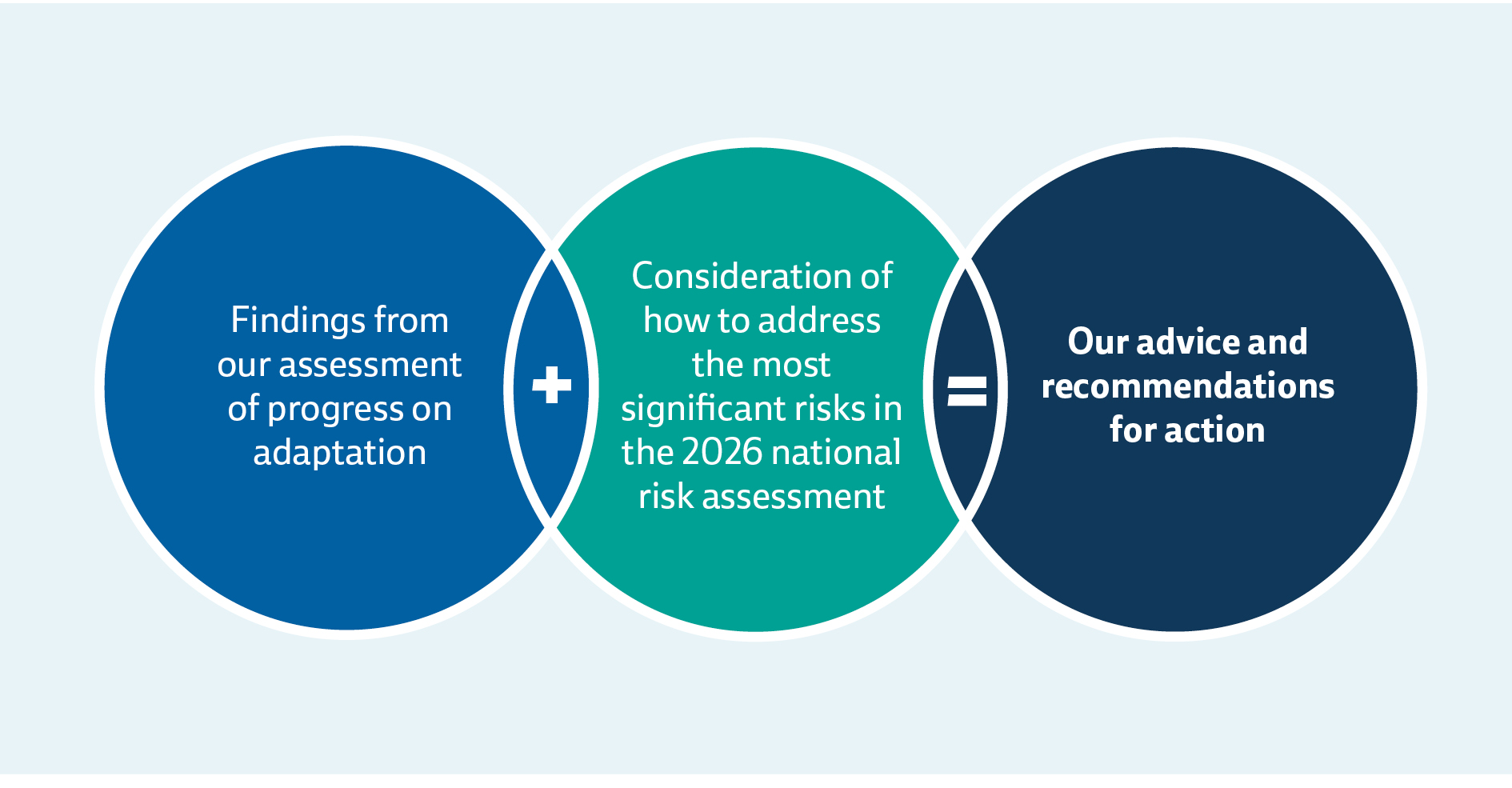
Figure ES.1: How our progress assessment becomes advice and recommendations for action. Source: Commission analysis
Next steps: An opportunity to drive action
This report comes as government agencies begin work on the new national adaptation plan that will address the latest assessment of climate risks. That plan is due in 2028.
The next plan provides an opportunity for the Government to achieve real reductions in the country’s climate-related risks. With well designed fundamentals in place, the plan will be able to drive adaptation action across Aotearoa New Zealand with the breadth and speed needed.
Strong strategic direction and coordination by central government can build resilience and readiness across all sectors and communities, at national, regional and local levels. This can harness the interests and efforts of diverse groups, helping guide combined efforts to achieve benefits for everyone, over the short, medium and longer term.
Summary: Part A
Our advice and recommendations for action
We have identified six key focus areas for immediate action, to create the foundations needed for effective adaptation (Figure ES.2). There are gaps in the core structure that are slowing progress and need addressing with urgency, including in the next national adaptation plan.
These gaps were also identified in our 2024 progress report. The elapsed time increases the urgency of action, as the effects of climate change continue to rise, so we are being more specific about what is needed, and who needs to act.
There is a recommendation made for each foundational element, identifying initial steps for central government to take, and the responsible minister/s (see Our recommendations at a glance table).
Each element is a necessary part of the adaptation response. The six can be described separately, but they interlink and need coordinating for effective action across the country:
- being clear how the costs of adaptation action will be paid for
- putting in place legal requirements for local adaptation planning, with appropriate guidance, tools and funding options
- building climate adaptation into key legislation
- improving national data and making it more accessible and usable for all
- ensuring iwi/Māori can plan for and carry out adaptation action
- making the next national adaptation plan a stronger driver of action.
The core recommendations are supported by advice on what central government needs to do to implement each recommendation. This advice is summarised here, and set out in full in Chapter 2: Advice and recommendations for action.
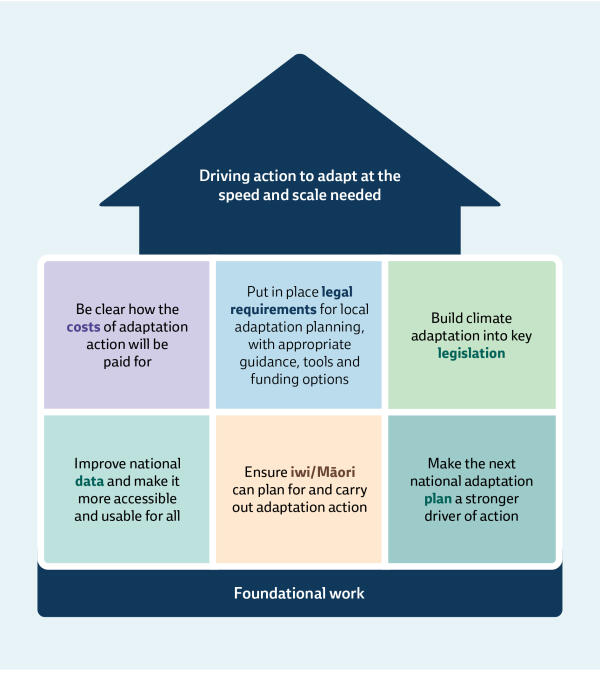
Figure ES.2: Foundations for effective national adaptation planning. Source: Commission analysis
Be clear how the costs of adaptation action will be paid for
Recommendation 1
We recommend that central government establishes funding and financing pathways to enable adaptation at a local level.
Responsible Ministers: Minister of Climate Change alongside Minister of Finance, Minister of Local Government
To implement this recommendation, focus on these areas:
- setting clear expectations for ‘what’ adaptation action central government will and will not fund
- working with local government and private sector organisations to develop or enable additional funding and financing mechanisms to support local adaptation action.
There is currently not enough resource available to support proactive adaptation in Aotearoa New Zealand. More investment will be needed to support effective adaptation at a local level. This is in addition to the government funding that goes toward disaster response and recovery following a severe weather event. Proposed legislation to require local adaptation plans in priority locations (also referred to as priority areas), while an important step forward, will increase the gap between what is required and funds available to local government.
Investing in proactive adaptation would reduce future costs and losses associated with climate change. Central government has a key role in unlocking new investment in adaptation at a local level. First, there is a role for central government to provide co-funding for adaptation action – identifying what action central government will or will not fund is critical for understanding the scale of the funding gap. Secondly, central government has a role to play in working with local government and private sector organisations to develop and enable new kinds of funding and financing mechanisms to help bridge the funding gap.
Put in place legal requirements for local adaptation planning, with appropriate guidance, tools and funding options
Recommendation 2
We recommend that central government puts in place legislative requirements for local adaptation planning, along with appropriate tools and guidance, to ensure that adaptation planning is a priority for local government.
Responsible Ministers: Minister of Climate Change alongside Minister of Finance, Minister of Local Government
To implement this recommendation, focus on these areas:
- setting out clear roles and responsibilities for decision-making
- clear processes for local risk assessment
- framework for local government to weigh up the costs and benefits of different choices within local adaptation planning processes
- guidance and processes to support proactive and reactive relocation
- sufficient capability and capacity to support effective local adaptation planning and action.
Legal requirements are important for ensuring local government can prioritise and carry out effective local adaptation planning and implementation. Proposed legislation to require local adaptation plans in priority locations is a step toward this. However, it is currently unclear what criteria will be used to determine or define what a priority location is, and all local government needs to be appropriately enabled to plan for and carry out adaptation in their communities.
To enable effective adaptation, legal requirements need to be supported by appropriate tools and guidance to ensure there are clear roles and responsibilities, consistent approaches to assessing climate risks, adaptation measures and their costs and benefits, and clear processes for planned relocations. Sufficient capability and capacity to support effective local adaptation planning and action is also necessary.
Build climate adaptation into key legislation
Recommendation 3
We recommend that central government embeds climate change into key pieces of legislation that govern the natural and built environment and ensures they are aligned (not at cross purposes).
Responsible Ministers: Minister of Climate Change alongside Minister Responsible for Resource Management Act Reform, Minister for Building and Construction, Minister of Local Government, Minister for Infrastructure
To implement this recommendation, focus on these areas:
- planning and infrastructure legislation needs to ensure that adaptation is considered consistently
- ensuring that key legislation, national strategies and plans are integrated and aligned towards achieving effective adaptation outcomes.
Embedding climate change considerations into key pieces of legislation that govern the natural and built environment will be critical to achieving effective adaptation in Aotearoa New Zealand. Current laws are not well aligned, do not adequately cover challenges that climate change creates, and create risks of maladaptation.
As new legislation is developed, it will be critical that these changes are integrated and aligned to support a clear and coherent approach for adaptation.
This will require substantial effort and will take time to implement, but there is an opportunity to get started with current reforms to the country’s planning and resource management system.
Improve national data and make it more accessible and usable for all
Recommendation 4
We recommend that central government coordinates, governs and invests in building and maintaining national climate risk information and guidance to assist informed decision-making at all levels.
Responsible Minister: Minister of Climate Change
To implement this recommendation, focus on these areas:
- coordination, governance and sustained investment
- systems to support accessibility
- guidance and tools to support the effective use of climate-risk-related information.
The country needs high-quality information about the risks that climate change presents and the possible consequences across all aspects of life in Aotearoa New Zealand. Central government has a role to make sure that climate risk research, data collection and delivery of information to users is developed strategically and focused on key challenges, needs and gaps. It also needs to be accessible and usable for all New Zealanders. This will require sustained long-term investment and development of systems to support accessibility. Guidance and tools are needed to support the effective use of the information, including to support understanding of the uncertainty inherent in assessing future risks – so that people can clearly regard the range of potential impacts and act early to reduce them.
Example: The proposed New Zealand Flood Map provides an example of how our advice could be applied in a practical context to support better adaptation decisions. The flood map was initiated under the Government’s National Adaptation Framework, with development funding in Budget 2026.
Box 2.4 in Chapter 2: Advice and recommendations for action sets out what is needed for the flood map to deliver on its potential. This will depend on whether it is developed, maintained and used as part of a wider national climate-risk information system. The map will be most useful if it has clear governance, sustained investment, consistent data standards, broad accessibility, and guidance on how it should be applied in decisions.
Ensure iwi/Māori can plan for and carry out adaptation action
Recommendation 5
We recommend that central government establishes funding and financing mechanisms and models for iwi/Māori, so they can continue adaptation efforts in line with their tikanga and whakaarotau.ii
Responsible Ministers: Minister of Climate Change alongside Minister for Māori Development
To implement this recommendation, focus on this area:
- mechanisms are needed to directly allocate resources to iwi/Māori for adaptation planning and action.
Climate change is not only a physical or economic problem. There are specific social impacts from climate change that uniquely affect iwi/Māori. Climate change impacts reach into identity, language, knowledge, governance and intergenerational wellbeing for iwi/Māori. Within this context, targeted support and funding for iwi/Māori-led adaptation are appropriate and necessary – while also helping to ensure the Crown is meeting obligations under Te Tiriti o Waitangi/The Treaty of Waitangi to iwi/Māori that extend into climate adaptation.
It is also in Aotearoa New Zealand’s collective national interest to ensure that climate leadership and adaptation efforts led by iwi/Māori across the country are supported. Iwi/Māori having the ability to implement adaptation initiatives will ensure that localised perspectives, that are centred on hapori and appropriately grounded in mātauranga Māori, are a critical focus of national adaptation efforts. The benefits seen from iwi/Māori adaptation efforts to date show crossover benefits for entire communities, and by supporting iwi/Māori through funding, central government will be supporting adaptation outcomes for all of Aotearoa New Zealand.
Make the next national adaptation plan a stronger driver of action
Recommendation 6
We recommend that central government ensures the next national adaptation plan:
- has goals and objectives that will drive action at the pace and scale needed
- prioritises action based on the consequence and urgency of climate-related risks
- has investment and workforce strategies to support effective implementation of the plan.
Responsible Minister: Minister of Climate Change
To implement this recommendation, focus on these areas:
- the next national adaptation plan needs to be grounded in a clear understanding of risk, with direct links showing how actions in the plan will address the most significant risks
- the plan needs to set out what it is seeking to achieve over different timeframes, and how
- the plan needs to be driven and governed by those with clear accountabilities for actions
- the plan needs to set out the costs and benefits of its actions, and how they will be paid for
- the plan needs to include a strategy for workforce planning to be able to deliver adaptation action
- a monitoring and evaluation framework needs to be developed alongside the plan
- public participation and engagement are critical to developing an effective plan.
Without this foundation, it is difficult to coordinate effort or drive adaptation action at the pace and scale required, including at the local level. The next national adaptation plan is due in 2028 – there is opportunity to develop a plan that more effectively sets up Aotearoa New Zealand to respond to risks and adapt to a changing climate. Government agencies have already begun work to develop the next plan.
Our recommendations draw from our findings about progress under the first national adaptation plan (as set out in the following summary of Part B), recognising what is supporting or delaying effective adaptation.
Summary: Part B
Key findings about current national adaptation planning
Our 2026 assessment of progress has found adaptation is not keeping pace with escalating climate risks in Aotearoa New Zealand. The progress made since our 2024 assessment has been uneven and serious gaps remain. The work underway is not yet enough to make the country resilient to current pressures, let alone into future decades.
This section summarises the key findings of our assessment of current national adaptation planning – covering the first national adaptation plan published in 2022 and developments since its release, including updates to its actions table in 2025, and the National Adaptation Framework introduced by the Government in 2025.
The focus of our monitoring is on the implementation and effectiveness of the Government’s planning. Our approach places a strong emphasis on the quality of the plan itself, and on understanding the potential for current planning to drive effective adaptation (Box ES.1).
The assessment has four sections. Key findings for each are included in this summary.
- Progress towards achieving objectives (in the first national adaptation plan). This draws on and summarises all the other analysis.
- Pae Tawhiti Pae Tata with a focus on iwi/Māori and the Crown–Māori relationship.
- Quality of the plan, considering the elements of adaptation planning, and how well it addresses the most significant climate risks and the key adaptation challenges.
- Implementation and delivery.
Progress towards achieving the current plan’s objectives
Our assessment finds encouraging signs of progress towards objectives in some important areas, but overall progress is insufficient. There is a wide range of reforms underway, some which could assist, some which may hinder action. The signs of progress are early and fragile – and there remain fundamental gaps where urgent action is needed.
Our key findings in this chapter are shown under the outcome areas of the current plan.
The chapter also includes snapshots of action on the ground that provide a view of the diverse adaptation action happening across the country, including stories and photos, and notes on what is needed to build the momentum and scale needed to address risks.
Box ES.1: What makes adaptation planning effective
An effective response to a complex challenge like climate change requires understanding the issues, comprehensive planning that sets clear priorities, and responsive management. Our assessment of current adaptation planning in Aotearoa New Zealand draws on developing international practice, research and experience of adaptation practitioners. While there is no ‘single right way’ to plan climate adaptation, there are key steps that are essential to deliver effective action (Figure ES.3).3
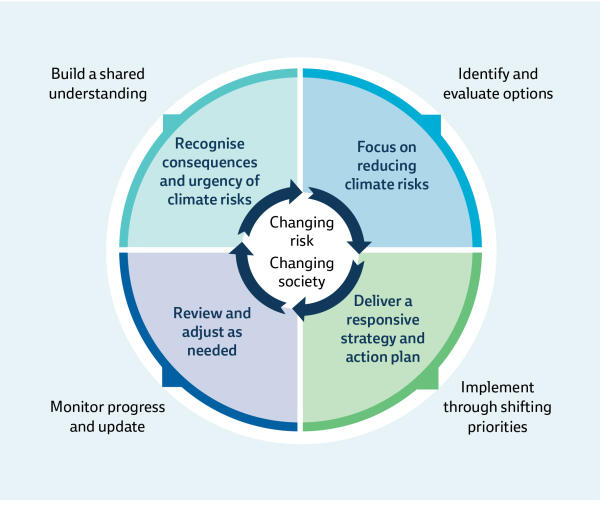
Figure ES.3: Key elements of effective climate adaptation planning. Source: Commission analysis drawing on international assessments of best practice4
System-wide objectives
- There has been some progress towards achieving the plan’s system-wide objectives, with moves towards clarifying some roles and responsibilities – including for councils in local adaptation planning – and increasing information available for decision-making.
- There is a lack of progress on decisions about how adaptation will be paid for, and little action towards unlocking investment in climate resilience. This has potential to delay progress across all objectives in the first national adaptation plan, and increase the likelihood of maladaptation (attempts to adapt that make a risk worse, or move the negative impacts elsewhere).
Natural environment
- There is some positive action to support climate-resilient, healthy, connected ecosystems, and to strengthen biosecurity (including strategies, planning, monitoring and mapping). This includes implementation of Te Mana o te Taiao – Aotearoa New Zealand Biodiversity Strategy 2020, along with the Department of Conservation’s Climate Change Adaptation Action Plan 2025–28. But there is limited evidence that actions are directly leading to better adaptation outcomes. Some actions towards achieving these objectives have been discontinued or removed from the first national adaptation plan.
- Nature-based solutions, including green infrastructure and catchment-scale initiatives, show great potential – for example, through Auckland Council’s Making Space for Water programme. However, this promise is limited by lack of action, and discontinued policies and funding.
Homes, buildings and places
- Improved focus on hazard information, planning tools and reforms that help avoid or limit development in areas with high exposure to climate risks are giving councils and communities a stronger basis for future decisions – for example, provisions in recent resource management reforms to clarify and strengthen councils’ ability to decline land-use consents or impose relevant conditions where there is significant natural hazard risk. However, progress is too slow in some important aspects that matter for long-term resilience of homes, buildings and places. Action is needed to align legislation with what is known about future climate conditions. A stronger focus is also needed on retrofitting existing buildings to improve resilience.
- There is little focus on supporting Māori-led adaptation, or on minimising the impacts of climate change on cultural heritage and wellbeing.
Infrastructure
- Understanding of infrastructure exposure is improving, with some infrastructure providers mapping risks, and the development of the New Zealand Flood Map is a positive step. However, gaps remain in some important areas. This includes around asset vulnerability, sector-wide coordination and knowledge sharing.
- Clarifying cost-sharing arrangements would help renewal programmes to contribute to the resilience of public and private infrastructure, including local government assets and services. Without this, decisions made now about maintaining, upgrading, repairing or replacing existing infrastructure could potentially lock in inappropriate infrastructure for many decades and lead to maladaptation and inequities.
Communities
- Progress on community-level adaptation is slow and uneven, with much central government action centred on producing and sharing information. Communities receive support after severe weather events in a range of ways, but this is often unpredictable and inconsistent. Opportunities remain to ensure consistent, long-term support to enable communities to adapt. This is particularly important for iwi/Māori and for vulnerable groups.
- Proposed reforms related to local adaptation planning may better enable local government and communities to plan and adapt, but are in early stages, and no decisions have been made about how local adaptation planning and action will be paid for. The delivery of the Health National Adaptation Plan 2024–2027 is positive, but its effectiveness depends on timely and effective resourcing and delivery of the actions in the plan.
Economy and finance
- Action to support the private sector and regional economies to adapt, and to support the resilience of the financial system, is insufficient. The agriculture sector is the focus of some government action, but other sectors less so.
- Without incentives to reduce exposure to climate-related hazards, or new funding and financing tools to unlock investment, decisions by businesses, property owners and others could increase fiscal exposure and create stranded assets, or lead to maladaptation (by increasing or shifting climate-related risks). This could undermine action across all objectives in the national adaptation plan.
- Increasing insurance costs also create potential for widespread economic impacts.
- Opportunities remain for sectors, businesses and regional economies to invest in skills, knowledge and capability to advance effective climate adaptation.
Pae Tawhiti Pae Tata
Iwi/Māori are driving significant climate adaptation work, but a lack of consistent government support and processes aligned to supporting the Crown–Māori relationship limit their ability to lead effectively and contribute to national adaptation efforts.
Iwi/Māori are leading climate adaptation initiatives across Aotearoa New Zealand, with many hapū, marae and pakihi Māori driving action that strengthens resilience, protects taonga, and supports communities during climate events.
The first national adaptation plan does not adequately address key challenges facing iwi/Māori, and stronger government action is needed to remove barriers that slow or limit iwi/Māori-led adaptation.
- There is opportunity for central government to accelerate adaptation action by providing a sufficient and sustainable approach to funding, and greater certainty and clarity around roles and responsibilities at the national and local level. These are critical for effectively supporting the significant adaptation efforts that are ongoing among iwi/Māori.
- It is also important to address potential impacts of relying on relationships that depend too heavily on local political will, rather than shared decision-making and consistent processes that are aligned with Te Tiriti o Waitangi/The Treaty of Waitangi. It is currently unclear what roles and responsibilities iwi/Māori have in adaptation planning at a national and local level.
- In wānanga and other kōrero we have heard that useful tohu for monitoring adaptation for iwi/Māori would be: funding allocation for Māori-led climate initiatives, iwi/Māori adaptation plan coverage, and iwi/Māori representation in governance structures. We will continue to build out tohu in future reports.
A description of the whakataukī that gives this chapter its name is included in the chapter, along with a glossary of terms in te reo Māori.
Quality of the plan
Our assessment found the action planned and underway is not setting the country up to adapt to climate change effectively.
- Current national adaptation planning does not set out goals and prioritise actions based on a clearly explained understanding of climate risk. There is no clear link between actions, objectives, goals, and the most significant and urgent risks.
- Even if all the actions set out in the first national adaptation plan (and its additions) were completed, they would not be sufficient to effectively reduce the most significant climate-related risks.
- While there is some progress on addressing important challenges and barriers to effective adaptation, there are still significant gaps.
Implementation and delivery
Our assessment found that, across all outcome areas, progress is uneven and critical gaps remain.
- Gaps of note relate to delivery of actions focused on support for Māori-led adaptation, unlocking investment, nature-based resilience, support for vulnerable people and displaced communities, and financial system preparedness. These gaps undermine the ability to deliver adaptation at the pace and scale required.
- Funding constraints, implementation delays and changing government priorities continue to affect delivery of some actions.
- There is no clear system for monitoring how sector-specific adaptation plans are being implemented once developed, although delivery of plans are important national adaptation actions themselves.
- There are some inconsistencies in agency reporting, and a lack of clarity around delivery milestones, which make progress difficult to assess.
More info
The full report and supporting information are available at the top of this web page.
Consult the following sections of the full report for more information about these topics:
- Chapter 1: Introduction
- Chapter 2: Advice and recommendations for action
- Chapters 3–7: Assessment of current planning