Emissions reduction monitoring
2026 Monitoring report: Emissions reduction
Assessing progress towards meeting Aotearoa New Zealand’s emissions budgets and the 2050 target (2026)
22 July 2026
About this report
This is the Commission's third monitoring report on emissions reductions. This report looks at how well current emissions reductions policies and plans set the country up to meet its climate goals.
The report tracks emissions reductions overall, as well as the Government's progress towards meeting the second and third emissions budgets and the 2050 target.
This advice is required under sections 5J, 5ZJ and 5ZK of the Climate Change Response Act 2002.
Details & links
Monitoring report: Emissions reduction – Assessing progress towards meeting Aotearoa New Zealand’s emissions budgets and the 2050 target (July 2026)
3021-2650 (Print); 3021-2669 (Online)
A summary of our findings and recommendations, excerpted from the main report.
This summary is available as a HTML web page below, or can be downloaded here:
Download:
Executive summary [PDF, 1.7 MB]
This one-page summary gives an overview of the 2026 report, outlining our key findings and recommendations.
Download:
One-page summary [PDF, 2.0 MB]
This summary gives a snapshot of greenhouse gas emissions in four areas: fossil fuel supply, buildings, industry, and electricity supply.
Download:
Energy, industry and buildings sector summary [PDF, 449 KB]
This summary gives a snapshot of greenhouse gas emissions from three areas: passenger transport, freight transport and aviation.
Download:
Transport sector summary [PDF, 268 KB]
This summary gives a snapshot of greenhouse gas emissions from two areas: reducing emissions from farming, and moving to land uses with lower emissions.
Download:
Agriculture sector summary [PDF, 268 KB]
This summary gives a snapshot of greenhouse gas emissions across three areas: reducing organic waste to landfill, landfill gas capture, and fluorinated gases.
Download:
Waste and f-gases sector summary [PDF, 335 KB]
This summary gives a snapshot of greenhouse gas emissions and removals by forests in three areas: afforestation and reforestation, deforestation, and forest management.
Download:
Forestry sector summary [PDF, 327 KB]
This provides a summary snapshot of progress, risks, and further opportunities centred on iwi/Māori. It also looks at the impacts of Government policy and action to reduce greenhouse gas emissions in iwi/Māori and on the Crown–Māori relationship.
Downloads:
Whakahekenga rehukino summary (te reo Māori) [PDF, 263 KB]
Whakahekenga rehukino summary (English) [PDF, 321 KB]
This document provides further information on the modelling and data that underpin our assessment.
Download:
Technical annex [PDF, 2.6 MB]
This spreadsheet contains data used to produce the figures in our 2026 emissions reduction monitoring report.
Download:
Report figures and data [XLSX, 3.8 MB]
The graphs, diagrams and tables from the report are available for download as .PNG files. These images are licensed for re-use under the Creative Commons Attribution 4.0 International licence.
Download:
Report image files [ZIP, 398 KB]
This spreadsheet contains quarterly emissions estimates by sector and greenhouse gas up to the December 2025 quarter. We used these data to produce provisional gross emissions estimates for the 2025 calendar year in our report.
These data are obtained from a customised data request to Stats NZ by the Climate Change Chief Executives Board, shared with the Commission. The spreadsheet is licensed by Stats NZ for re-use under the Creative Commons Attribution 4.0 International licence.
Download:
Stats NZ Quarterly greenhouse gas emissions by sector [XLSX, 145 KB]
These spreadsheets contain the assessment of the business case for the uptake of light EVs and low carbon technologies for process heat.
Download:
Technology business case spreadsheets [ZIP, 350 KB]
What changes to emissions goals mean for this report
Responding to changed conditions
Since the first three emissions budgets were set in 2022, there have been methodological improvements to New Zealand’s Greenhouse Gas Inventory and higher-than-projected rates of forest planting. This means the budgets can be achieved with less effort than was intended when they were set. In other words, the current budgets are now less ambitious than initially planned. Aotearoa New Zealand is therefore making less of a contribution to the global effort to limit warming than was considered feasible when the emissions budgets were set.
The Climate Change Response Act allows the Commission to advise the Government to revise emissions budgets if circumstances have changed since the budgets were originally set. This system of responding to changed conditions helps the country stay on course for achieving its long-term climate goals.
Our 2024 recommendations
In November 2024, the Commission provided advice to the Government on two key parts of the emissions reduction system:
- The 2050 target. Here we recommended strengthening the target to require greater levels of biogenic methane reductions and net negative emissions (removing more than are emitted) of all other greenhouse gases.
- Advice for the fourth emissions budget (2036–2040). As part of this advice, we recommended that the first three emissions budgets were revised to re-align them with the original intent. Updating the budgets would encourage the real-world reductions that were deemed feasible at the time they were set.
The Government’s response
In December 2025, the Government responded to our advice by amending the Climate Change Response Act to:
- Lessen the reductions of biogenic methane required by 2050 and leave the net-zero gas emission requirements of the 2050 target unchanged.
- Delay the decision to set and revise emissions budgets until 2027.
These changes mean the Act now allows for higher greenhouse gas emissions while still meeting the 2050 target. The delay to deciding on emissions budgets means the first emissions budget can no longer be revised as it has now ended, which means this budget was easier to achieve than originally intended.
Next steps
In early 2027, the Commission will provide updated advice to the Government on the fourth emissions budget based on the revised 2050 target. This will include our recommendations on updated revisions for earlier emissions budgets. The Government has until the end of 2027 to set the fourth emissions budget and consider revising the second and third budgets.
How we made this assessment
This report measures progress against the current budgets and plans, as required by the Act. Where possible, we compare progress to both the current and the revised budgets we recommended in 2024. This shows how much additional action would be required to achieve the level of emissions reductions that were originally intended.
Executive summary
This summary has been adapted from the beginning of our full report. It is available below as HTML web content, or can be downloaded as a document: Executive summary [PDF, 1.7 MB]
Our findings at a glance
Climate disruption and economic impacts in Aotearoa New Zealand are growing – greater and more durable emissions reductions are needed to manage these risks.
- Delaying action increases disruption and costs for households and the economy, and narrows the country’s options.
Greenhouse gas emissions are gradually falling, but the reductions are unlikely to be enduring, and the pace needs to more than double.
- After declining since 2019, gross emissions reductions stalled in 2024, largely due to a dry year that meant coal was used to generate electricity. Emissions estimates for 2025 suggest this was temporary, but this highlights the need for greater buffers against external factors.
- Recent reductions in industrial emissions are largely due to a drop in production, rather than changes in efficiency, technology or fuel switching.
- Net emissions continued to fall in 2024 due to increased forestry.
The second emissions budget (2026–2030) is at increasing risk.
- Projections show the second emissions budget could still be met by 3.6 MtCO2e, but more than half of the reductions planned, 12.4 MtCO2e, are at significant risk.
- Recent Government actions to reduce emissions are likely to be outweighed by other actions taken that may increase them.
- It is too late to plant additional forests to address any shortfalls in this budget.
Current plans and policies are insufficient to meet the third emissions budget (2031–2035) or the 2050 target, and the window for action is closing.
- Projections show the 2030 biogenic methane target will not be met. Government estimates show a 7.9% reduction in biogenic methane by 2030, compared with the 10% target.
- The gap in the emissions reduction plan for the third budget has not been significantly addressed since our last report and the risks to planned reductions have increased.
- If additional action does not occur in the next one to two years, it will no longer be feasible to meet the 2030 biogenic methane target or the third emissions budget.
Acting earlier to reduce emissions can strengthen resilience, reduce exposure to shocks, and lower costs for households, businesses and the country.
- Recent high oil prices forced many households to change their spending, including on necessities. Greater uptake of low-emissions technologies would reduce exposure to these shocks and help manage cost-of-living pressures.
- Some actions will require upfront investment, but acting sooner will reduce costs overall and make the transition to a low-emissions economy smoother.
Our recommendations for decision-makers
Last year, we recommended that the Government put additional policies in place to reduce the risk of missing the third emissions budget. In its response, the Government indicated it would consider further action. Since then, that risk has increased, and the 2030 biogenic methane target is no longer projected to be met.
The time available to correct course is now short. Many emissions reductions depend on decisions made well before the reductions are realised, and some options for the second emissions budget are no longer available.
This increases the importance of taking action now in the areas where barriers, delays and weak incentives are holding back progress.
It also increases the importance of emissions projections providing a robust indication of likely policy impact. In some areas, the assumptions underlying the projections do not appear to be driven by a realistic assessment of current policy.
Recommendation 1
We recommend that the Government takes action to address market barriers and failures within the next year to ensure it can meet its emissions goals, including:
- start determining how to incentivise further emissions reductions and removals in the 2030s given that the New Zealand Emissions Trading Scheme in its current form will struggle to do this
- for the primary sector:
- immediately scale up support measures to meet the 2030 biogenic methane target
- reduce barriers for high-value, low-emissions agricultural products for long-term reductions and resilience
- expand resource recovery facilities, services and planning, and extend landfill gas capture requirements to class 2 landfills
- encourage electric vehicle uptake through strong supply- and demand-side measures, and support greater shifts to public and active transport
- address upfront cost barriers to fuel-switching for households and businesses.
Recommendation 2
We recommend that the Government update its approach to emissions projections to ensure they provide a robust indication of likely futurepolicy impact.
Key findings
Question 1: What progress have we seen in emissions reductions to date?
The numbers
- After declining steadily since 2019 (by around 2.3% per year), gross greenhouse gas emissions reductions stalled in 2024, dropping only 0.12% (or 0.09 MtCO2e) from 2023. While there were some reductions, a dry year for hydro meant that coal was used to generate electricity – demonstrating the impact of not having a significant buffer.
- After removals from forestry are included, Aotearoa New Zealand’s projected net emissions (under target accounting rules) declined by 2.0% between 2023 and 2024.
- Provisional estimates indicate that gross emissions fell 2.3% in 2025 compared with 2024.
- Recent reductions in industrial emissions are largely due to a drop in production, rather than changes in efficiency, technology or fuel switching.
The first emissions budget
- Projections show the first emissions budget (290 MtCO2e) is likely to be met with a 7.7 MtCO2e buffer. The Commission’s end-of-budget report in 2027 will give a full assessment using final emissions data.
- Since that emissions budget was set, changes to New Zealand’s Greenhouse Gas Inventory mean the budget can now be met with less effort than it originally required.
- If the budget had been re-aligned with its original intent as the Commission recommended in 2024, projections show that it would likely be met by 0.7 MtCO2e.
The technology
- Technology changes are making it easier and more cost-effective for households and businesses to reduce emissions, as well as offering greater benefits.
- Battery costs have fallen 75% globally since 2015. This is improving the availability and cost of electric vehicles (EVs) and rooftop solar panels, and increased finance options are providing greater access.
- Progress on agricultural technologies continues, although there have been some delays to implementation to ensure regulatory approvals are robust. It is not yet clear if markets will take up these technologies without Government policy direction.
The policy
The Government has taken or signalled some actions to reduce emissions in the last year, however these are likely to be outweighed by other actions that may increase emissions.
- Policy actions that could reduce emissions include:
- improved energy regulatory measures
- extending the road user charges exemption for electric heavy vehicles
- passing legislation to enable time-of-use charging for transport systems
- the Gas Transition Loan Guarantee Scheme, which was announced after our assessment period ended.
- Actions that could increase emissions include:
- excluding agriculture from emissions pricing
- changes to the Clean Vehicle Standard
- increasing the mandatory climate reporting threshold for listed companies
- delays implementing a regulated product stewardship scheme for refrigerants
- committing to a liquefied natural gas (LNG) import facility. The LNG import facility for dry-year firming runs the risk of signalling delay to the transition from fossil fuels, which is likely to affect the pace of emissions reductions.
- Some actions will have an unclear effect on emissions, including merging multiple departments into the new Ministry for Cities, Environment, Regions and Transport, and reforming the resource management system.
- The ministry merger, the Māori Climate Platform’s funding cycle ending, and the merger of Crown Research Institutes may also have implications for Crown–Treaty responsibilities, iwi/Māori relationships and recognition of mātauranga Māori in decision-making.
The issues
- The 2026 National Climate Change Risk Assessment shows that the climate-related risks facing Aotearoa New Zealand are serious and increasing, affecting people, places and way of life.
- Reducing emissions and adapting to climate change in tandem will reduce the country’s exposure to climate disruption, at lower cost and with greater benefits, as well as avoiding inadvertent negative effects.
- While there is uncertainty caused by geopolitics, improvements in the cost, efficiency and performance of clean technology are continuing to drive change globally. Aotearoa New Zealand needs to determine how it wants to be positioned within these changing dynamics.
- The increase in oil prices from the 2026 conflict in the Middle East has underlined Aotearoa New Zealand’s vulnerability to fossil fuel supply chains, putting financial pressure on households. Increased electrification and greater EV uptake would have supported the country’s resilience against these shocks.
- Falling domestic gas supply is putting pressure on gas and electricity prices. The potential for imported LNG would increase the country’s exposure to global instability further, and could result in higher costs and emissions compared to alternative options.
- The Government has chosen a market-led approach to emissions reductions, however evidence suggests the New Zealand Emissions Trading Scheme (NZ ETS) is not efficiently driving emissions reductions now, due to low market confidence, price volatility, and uncertainty about the long-term future of the scheme.
- High levels of forest planting continue, which risks reducing the incentive to lower emissions in other sectors.
Question 2: How is the country tracking towards meeting the current emissions budget?
The numbers
The second emissions budget (2026–2030) is at significant risk, and that risk has increased in the last year.
- The Government’s projections show that the second emissions budget is likely to be met by 3.6 MtCO2e.
- However, our assessment has found that those projections are increasingly at risk: in 2024, most planned reductions in this budget were at moderate risk. This year, more than half are at significant risk.
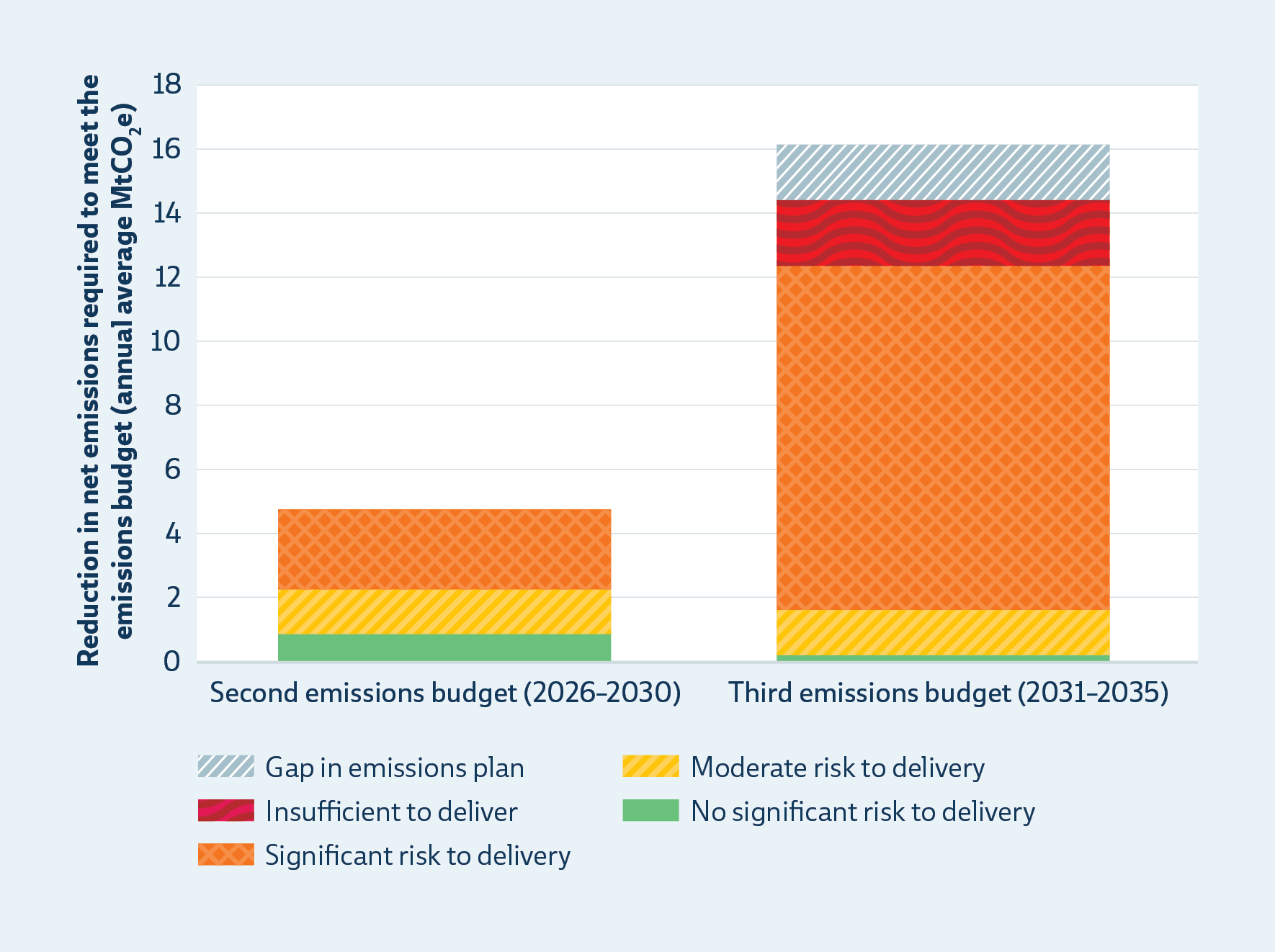
Figure ES.1: Overall assessment of risk to meeting the emissions budgets under current policies and plans
The risks
- Electricity, increased to significant risk: Due to falling gas supply and continued difficulty securing low-emissions solutions to dry years and demand peaks. Imported LNG would not begin until the middle of the budget period, and could end up increasing emissions.
- Agriculture, increased to significant risk: Current market drivers, such as high milk and meat prices, point to increasing emissions from higher production. Market incentives may improve emissions intensity but not deliver absolute emissions reductions.
- Transport, increased to significant risk: Largely due to changes to the Clean Vehicle Standard and its potential removal.
- Fluorinated gases (f-gases), increased to moderate risk: Due to delays implementing a regulated product stewardship scheme for refrigerants.
- Industry, decreased to moderate risk: Due to greater confidence largely from the implementation of Government Investment in Decarbonising Industry (GIDI) partnerships such as the NZ Steel electric arc furnace project.
- Forests, unable to provide further buffer: There is no capacity for additional forestry planting within the second emissions budget to address any shortfalls or provide buffers. This is due to the low level of carbon absorbed by trees in the initial years following planting, along with the immediate emissions increases from changing land uses.
- Crown–Māori relationship: The Government is also at risk of not meeting its obligations to iwi/Māori under Te Tiriti o Waitangi/The Treaty of Waitangi. The Māori Climate Platform remains underfunded and there is no pathway for Crown–Māori engagement after it ends. Māori-led climate efforts grounded in intergenerational and te ao Māori principles are not matched by Crown partnership or resourcing, and there is a lack of emissions and economic data for Māori entities.
Question 3: How is the country tracking towards meeting future emissions budgets and the 2050 target?
The numbers
Current plans and policies are insufficient to meet the third budget or the 2050 target.
- The gap in the emissions reduction plan for the third budget has not been materially addressed since last year’s report.
- Our assessment of risk has increased in the last year, with most areas of emissions reductions now at significant risk.
- Current policies are unlikely to be enough to meet the 2050 target unless further action is taken.
Current Government plans are insufficient to achieve the 2030 biogenic methane target.
- Projections indicate that the 2030 biogenic methane target will not be met.
- Government estimates show a reduction of 7.9%, compared to a target of 10%.
The risks
- Forestry: Expected to contribute 49.3% of emissions reductions in the third budget period. Reliance on one sector increases the vulnerability of achieving the budget.
- Agriculture: Planned policies are now insufficient to deliver the required reductions. Agricultural emissions pricing has been removed from the Government’s emissions reduction plan, and current or planned policies or industry schemes would not achieve the reductions modelled in Government projections.
- Industry: Significant risk remains as almost all reductions to date are from projects funded by GIDI, which has been disestablished. Beyond the remaining GIDI projects, there is no policy to drive another wave of projects for the third budget. While an important signal, the 2037 coal boiler ban may not drive conversions quickly enough to materially contribute to either the second or third budgets. The Gas Transition Loan Guarantee Scheme, announced after our assessment period, is a step in the right direction toward addressing upfront cost barriers to fuel switching.
- NZ ETS: Market confidence is fragile, and in its current form, we expect the NZ ETS will be unable to incentivise further emissions reductions or removals from around 2034 onwards without further interventions. Industrial allocation remains misaligned with the 2050 target; under current forecasts units would continue to be allocated to 2050 and beyond.
- Workforce: Workforce availability may already be holding back the pace of industrial decarbonisation, particularly in the energy and engineering workforce. Workforce capacity issues could become more significant if policy ambition and investment accelerate in the future.
Question 4: How can Aotearoa New Zealand ensure it meets future emissions budgets and the 2050 target?
The numbers
- Aotearoa New Zealand needs to more than double the current pace of decarbonisation to meet the second and third emissions budgets and the 2050 target (see Figure ES.2). This is feasible with additional action.
- If additional action to address market barriers and failures does not occur in the next one to two years, it will no longer be feasible to meet the 2030 methane component of the 2050 target or the third emissions budget.
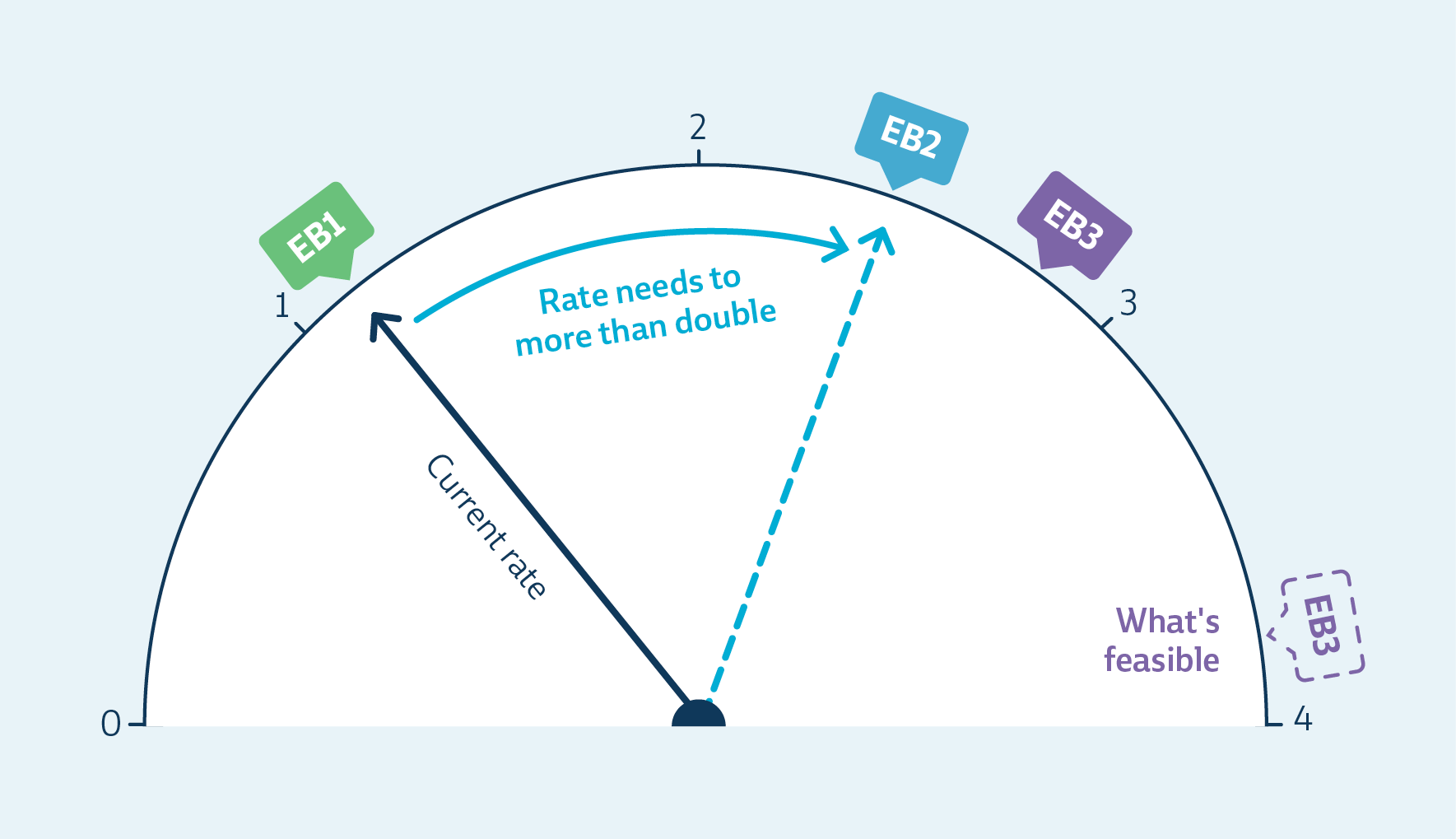
Figure ES.2: Increases in the rate of decarbonisation required to meet future emissions budgets (annual average MtCO2e)
The opportunities
Acting now to reduce emissions can strengthen resilience, reduce exposure to future shocks, and lower long-term costs for households, businesses and the country.
- Greater uptake of technologies like EVs and industrial heat pumps would deliver economic benefits to businesses and individuals as well as significant emissions reductions. These make sense to adopt now, although some barriers to uptake remain (see Figures ES.3, ES.4 and ES.5).
- Household cost pressure is already real: 29% of New Zealand households report cutting their spending on necessities in response to recent high oil prices. Some of the most practical near-term actions to reduce emissions would also reduce households’ exposure to fuel-price shocks and lower costs over time, as well as reducing air pollution and adding health benefits.
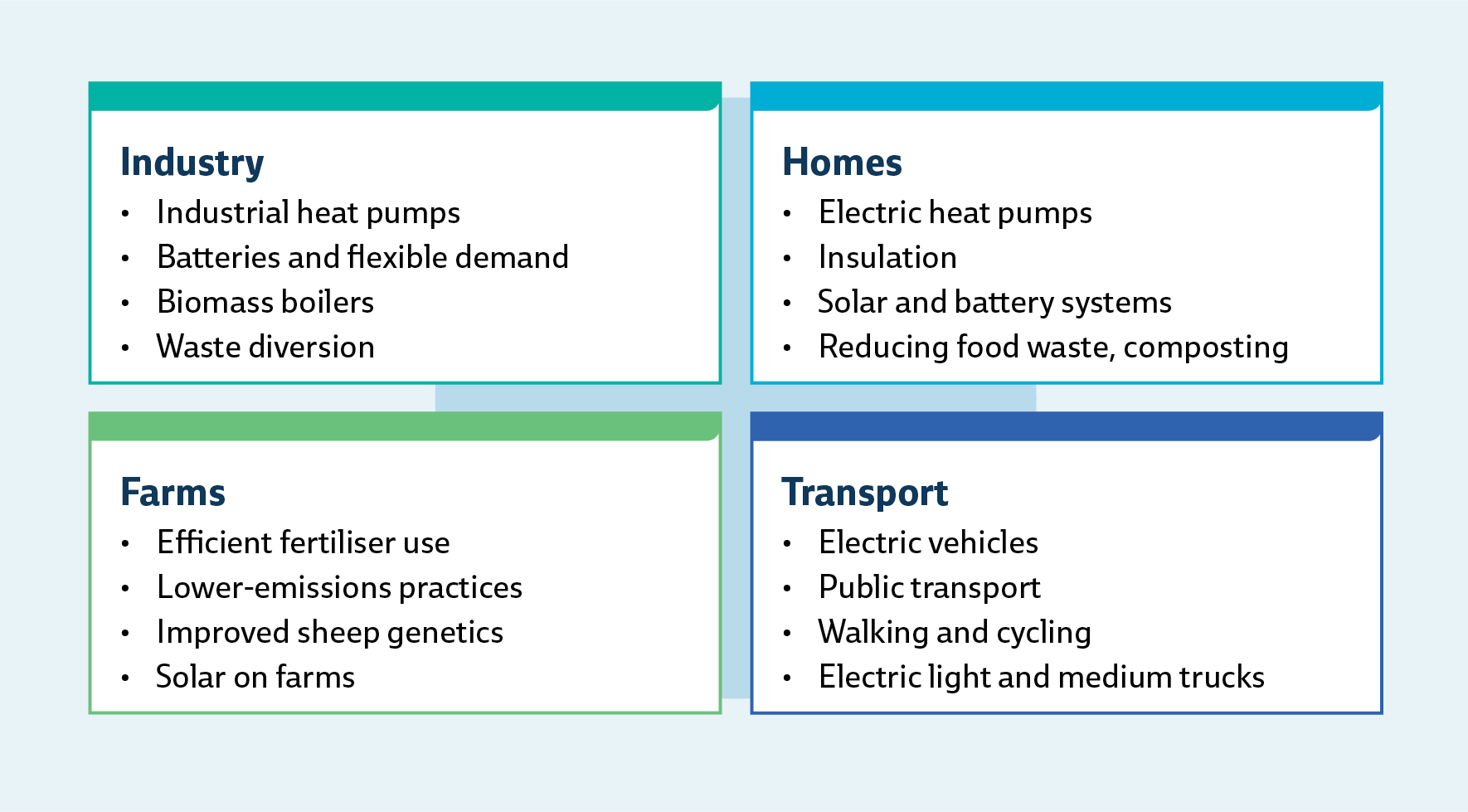
Figure ES.3: Actions with clear benefits for households and business to adopt now
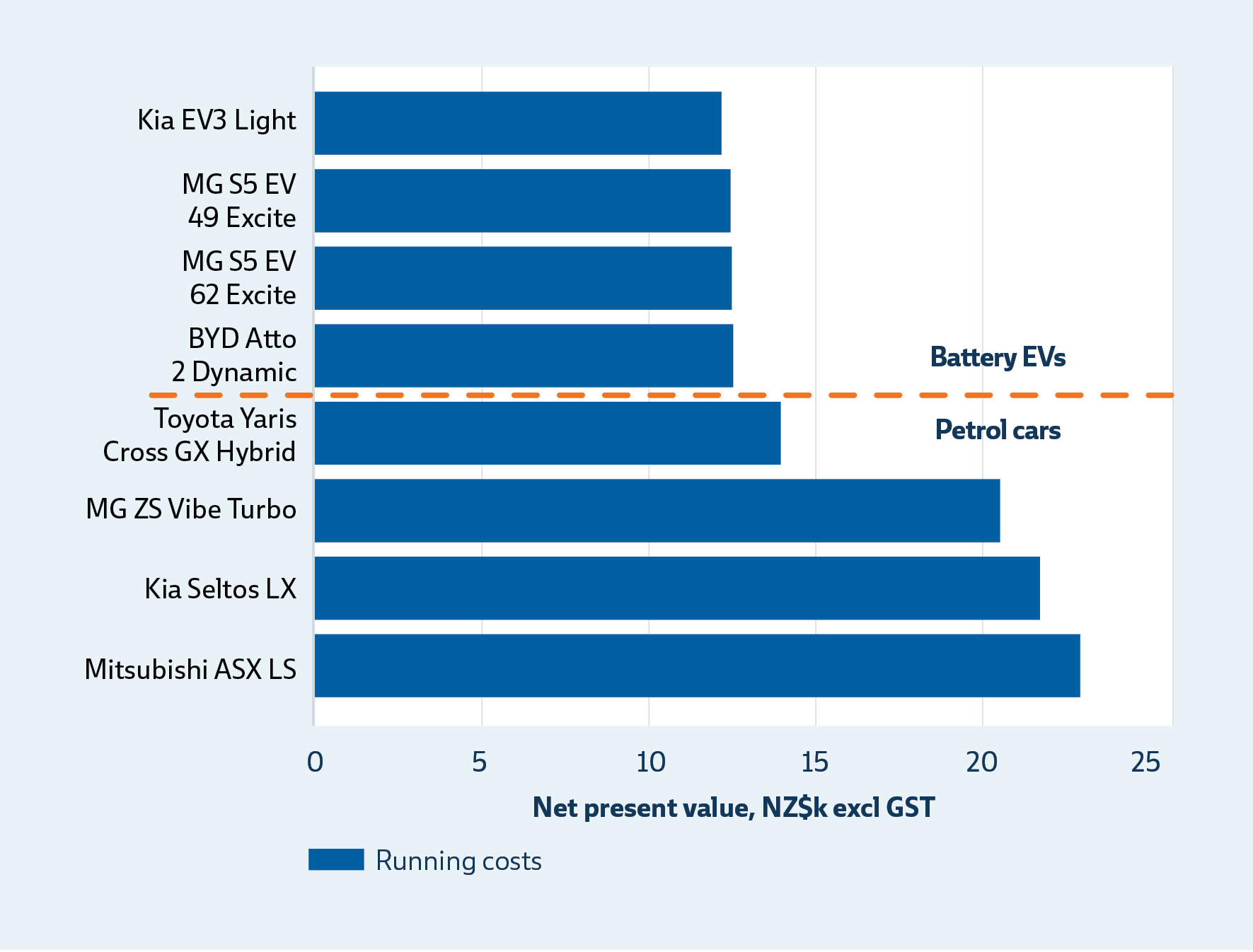
Figure ES.4: Five-year running costs for comparable compact sports utility vehicles (SUVs)
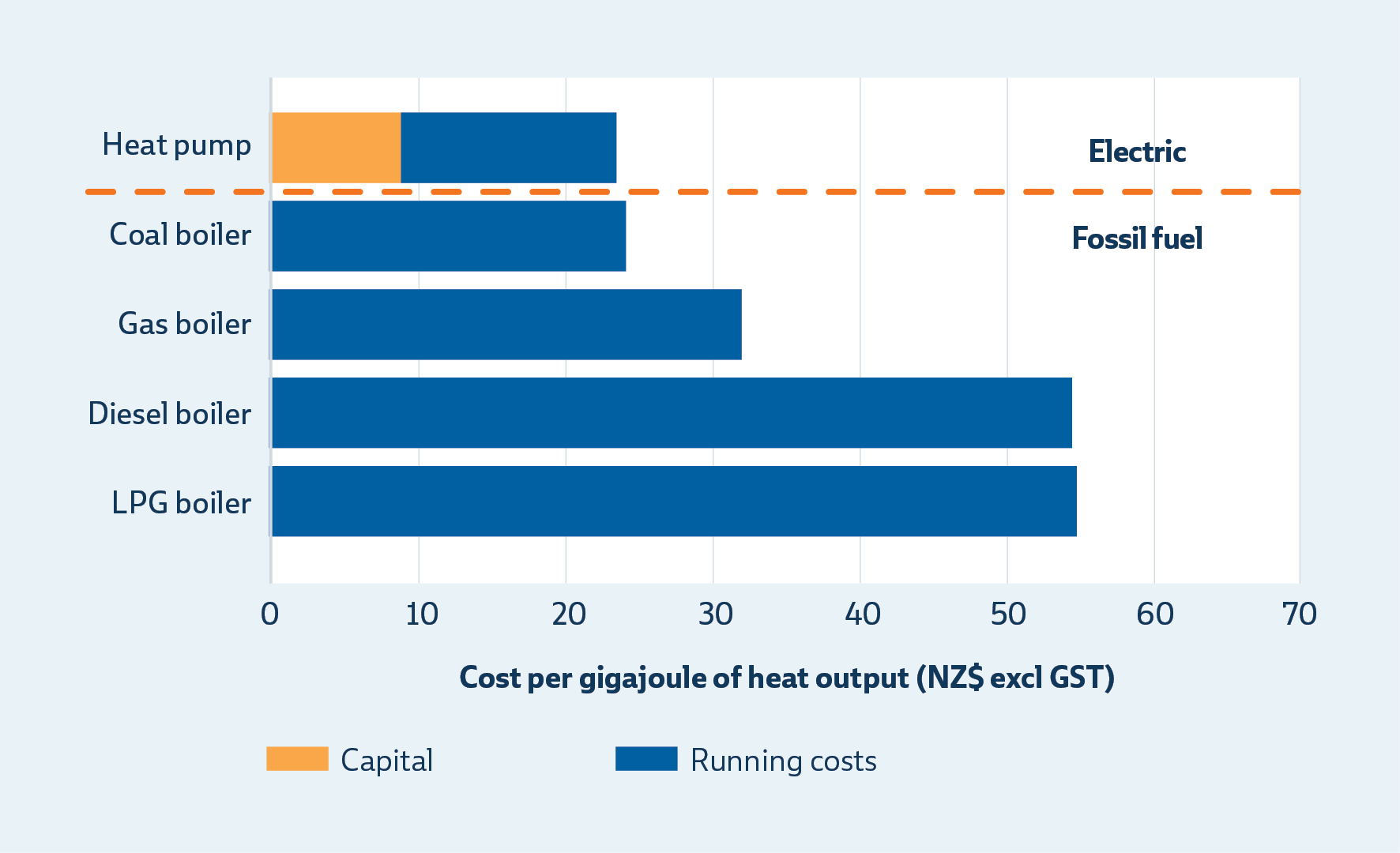
Figure ES.5: Cost of installing and running a new heat pump compared with running existing fossil fuel boilers
A system-wide approach would remove barriers, provide stability for climate investments and address the market failures that mean the NZ ETS is no longer providing a long-term investment signal.
- Some actions can be implemented immediately, others require system-level shifts; some are long-term pieces of work and others require significant investment – a cohesive approach would maximise the benefits from all actions.
- Without this, there is a risk that future emissions reduction will not occur or will be driven by reduced demand and business closures instead of sustainable changes to technology and behaviour.
Some actions will require upfront investment, but provide enduring economic benefits.
- Delaying action will increase costs (including the cost of living) for households and the economy. Greater action is necessary, and managed costs now are preferable to forced shocks later.
- The upfront costs of installing household solar and battery systems can now be paid off through savings in just 7–10 years, and in 5 years for some electric vehicles. Over their lifetime these investments generate significant cost savings for households.
- At the same time, some barriers that prevent households from taking up emissions reducing technology can be removed through policy at little or no financial cost to the Government. Failing to address them can cost the Government and economy in other ways.
- Rapidly increasing effects of climate change underline the urgency to reduce emissions and avoid the most expensive adaptation and recovery scenarios in the future.
Acting sooner rather than later will reduce costs and make the transition to a low emissions economy smoother.
- Modelling for the Sustainable Business Council indicates that the country’s gross domestic product would be NZ$22 billion higher by 2035 if we take action now to decarbonise our economy instead of continuing to emit at the current level.
- Many actions to reduce emissions have long lead-in times and require work now.
- Investments in industry and forestry often take years before emissions reductions are realised and new technologies can take decades to research and develop.
- Major urban design and infrastructure investments are often cheaper and easier to implement early and much more expensive to shift from in the future.
- Decisions made now can risk locking the country into a higher-emissions and higher-cost future that is disruptive and expensive to course-correct from.
Read more:
Download the full 2026 monitoring report [PDF, 4.2 MB]
Read our media release about this report
Explore summaries of this report for different audiences and themes
Explore technical material for this report, including data, figures, supporting business cases, and more
Compare our 2025 monitoring report