Case studies
Case study: Te Taitokerau | Northland
Ā Te Taitokerau urutau i ngā āhuarangi: Responding to a changing climate in Te Taitokerau/Northland
4 December 2025
About this case study
This case study sets out what we saw and heard on our visit to the Te Taitokerau/Northland region in March 2025.
It aims to reflect what we heard from people living in the region about how climate change is affecting the region, and what people are doing in response.
The mana of the work comes from the voices of everyone who contributed.
We talked with a cross-section of people, including hapū and iwi, farmers and growers, businesses, community organisations, councils, and the Northland economic agency.
Alongside a wide range of other evidence we use to develop our formal assessments, the evidence from this case study feeds into our work on the 2026 national climate change risk assessment and the 2026 progress assessment of the Government’s national adaptation plan.
The views and opinions expressed in this case study are those of the people we talked to during and after a visit to the region in March 2025. This compilation of insights from that kōrero was created by the Commission, with the input of the people we talked to.
By publishing this as a standalone report, we hope to allow the insights the communities shared with us to be more easily accessed by others working in this space, in central and local government, businesses, communities and beyond.
We have produced this work in two formats: as a document and as a shorter, scrollable multimedia version.
Details & links
Ā Te Taitokerau urutau i ngā āhuarangi: Responding to a changing climate in Te Taitokerau/Northland
978-0-473-76784-6 (Print); 978-0-473-76785-3 (Online)
This work is licensed under the Creative Commons Attribution (CC-BY-NC-ND) licence. The work can be downloaded, copied or distributed in any medium or format in unadapted form only, for non-commercial purposes only, and only if attributed to the Climate Change Commission. To view a copy of this licence, visit https://creativecommons.org/licenses/by-nc-nd/4.0
For images that include people: Out of respect for the people photographed, we ask that these images only be used in the context of this case study.
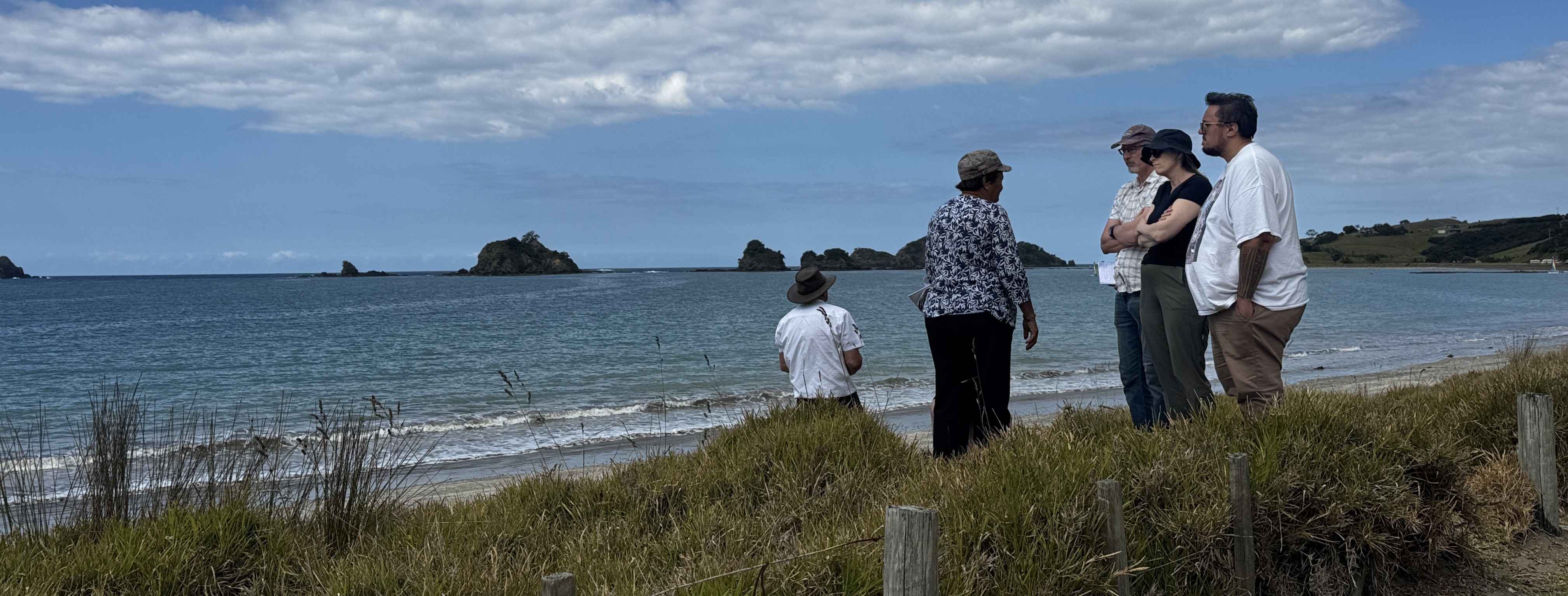
Ngātiwai kuia Bella Thompson shares stories of loss – and determination to hold on to local stories and mātauranga – with Commission visitors at Tuparehuia (Bland Bay). Photo / Whangarei District Council.
What this case study includes
The case study does not compare what people told us in the region with the adaptation action that the Government is already taking, including under the National Adaptation Framework published in October 2025. The assessment of government action will be a focus of our 2026 reports, particularly the second monitoring report on progress made under the Government’s national adaptation plan.
The case study illustrates the innovative responses people are building to diverse climate challenges in the region.
The questions at the heart of this case study are:
- Innovation and strength building – what makes it happen?
- What drives the action – what climate risks are people facing?
- What support do locals want – what helps, what gets in the way?
The stories are organised by the themes that emerged as we listened. They reflect innovative responses to a changing climate – practical approaches, connections and systems:
- Primary sector resilience and early adaptation
- Growing resilience in hapori Māori
- Collaborating at a catchment level
- Adaptation in a network of rivers and streams
- Keeping connected – the supporting infrastructure.
The final section summarises the support and action people said they need to succeed.
For our adaptation work programme, case studies like this are critical for gaining and sharing understanding because they are local. Climate impacts and responses are inherently localised – a national view is important but won’t provide a complete picture.
Read the case study
Explore a scrollable multimedia version of this report
Download the full case study (PDF, 2.4 MB)